
Key Focus
- The Ministry of Culture and Tourism introduces cultural industry development measures for the “Fifteenth Five-Year Plan” period — by 2025, total national cultural industry assets will reach RMB 37.4 trillion, with operating revenue exceeding RMB 20 trillion; efforts will be made to strengthen content originality and technological innovation, develop new business forms such as digital animation, digital art and immersive performances, and promote the expansion of online literature, online dramas, online games as well as animation, performing arts, trendy cultural and creative products, and game and amusement equipment into overseas markets.
- The Shanghai No. 1 Intermediate People’s Court hears on appeal Shanghai’s first dispute over protection of sound rights in AI-synthesized voice — it clarifies that, without a natural person’s consent, using his or her voice as training corpus and generating a synthesized voice sufficient to identify that person’s identity for commercial activities constitutes an infringement of sound rights; where training data are controlled by the platform, the platform shall bear the corresponding burden of proof regarding the legality of the sources of the materials, and the court ultimately upholds the award of RMB 50,000 in damages.
- The Sichuan High People’s Court, in the second instance, hears an infringement dispute concerning micro-short dramas on the Kuaishou platform — it finds that although Kuaishou did not directly upload the videos in question, it failed to take timely action after receiving copyright alerts and specific infringement notices, thereby constituting contributory infringement; it upholds the order that Kuaishou pay RMB 300,000 in damages, and modifies the judgment to require that, in addition to deleting infringing content, Kuaishou shall also adopt effective measures such as filtering and blocking.
- The Hainan Free Trade Port Intellectual Property Court hears at a higher level a dispute concerning a video platform’s infringement of the right of communication through information networks — it clarifies that, where a platform has received copyright alerts and infringement notices and possesses the capability to review and identify content, it cannot merely perform the “notice–takedown” obligation, but must also adopt necessary measures such as filtering and blocking; the court orders the platform operator to pay a total of RMB 1,061,680 in economic losses and reasonable expenses.
- The Kaifu District People’s Court of Changsha hears a copyright infringement case involving AI-generated images — it clarifies that a natural person’s original intellectual input should be examined at three levels: front-end conception, generation control and back-end processing; as the prompts in question only set out general requirements and the subsequent modifications were merely technical adjustments, the court finds that the images concerned do not constitute works and dismisses all of the plaintiff’s claims.
News
- The Ministry of Culture and Tourism issues the “Fifteenth Five-Year Plan for the Protection and Transmission of Intangible Cultural Heritage”: it proposes using existing intellectual property tools to strengthen cross-departmental coordination and information sharing in the protection of intangible cultural heritage (ICH) intellectual property; it encourages the reasonable use of ICH elements to develop cultural and creative products and other specialty products, and promotes cross-sector cooperation between ICH inheritors, ICH workshops and protection institutions on the one hand, and sectors such as trendy toys, animation, games, film and television, and catering on the other, to develop co-branded products, cultivate original brands and create immersive experience products.
- The National Copyright Administration issues the twelfth batch of key works copyright protection alert list for 2026: the list covers programs related to the 2026 Nagoya Asian Games, 10 theatrical films including “Dunhuang Hero,” and 17 television dramas including “The Great Long March.”
- The National Radio and Television Administration convenes the third coordination meeting for the “Five Batches Project” under the premium micro-short drama creation and dissemination plan: it requires the promotion of premiumization, popularization and internationalization of micro-short dramas, supports live-action dramas and guides the regulated development of AI-generated dramas; key platforms shall provide broadcasting resources for high-quality works and strictly implement requirements on filing and review, license issuance and labeling.
- The Beijing Municipal Comprehensive Law Enforcement Corps for the Cultural Market issues the 2026 Beijing–Tianjin–Hebei law enforcement cooperation plan: it expands the list of “no penalty for first minor violation” items from 36 to 61, pilots unified benchmarks for administrative penalty discretion in the fields of copyright and performances, and strengthens coordinated law enforcement in the areas of publishing, copyright, online culture and the dissemination of non-compliant cultural content generated by AI.
- National box office for the 2026 Mid-Autumn Festival release window reaches RMB 271 million: weekend box office during the window increases by approximately 110% compared with the previous weekend, and single-day box office on the Mid-Autumn Festival exceeds RMB 100 million; the re-release of “Avengers: Endgame” tops the window, while domestic films such as “Welcome to Long Restaurant” and “Eight Immortals!” continue their long-run performance, demonstrating that classic IP and high-quality content still possess strong market appeal.
- Team China wins gold medals in the first two esports events in which it participates at the 2026 Aichi–Nagoya Asian Games: it defeats Team Thailand 3:0 in the finals of “Naraka: Bladepoint,” winning the first Asian Games gold medal in that event; it defeats Team Malaysia 4:0 in the finals of “Honor of Kings,” successfully defending its title.
Cases
- Two levels of courts in Hangzhou respectively conclude a civil public interest action for personal information protection involving AI face-swapping and a portrait rights infringement dispute: the Hangzhou Intermediate People’s Court orders two defendants who used AI face-swapping to bypass liveness verification and unlawfully process citizens’ personal information to make a public apology and pay public interest damages; the Hangzhou Internet Court finds that a network technology company infringed portrait rights by mass-synthesizing fake product endorsement videos featuring beauty bloggers, and orders it to pay RMB 20,000 in damages.
Key Focus
Ministry of Culture and Tourism introduces cultural industry development measures for the “Fifteenth Five-Year Plan” period: strengthening innovation-driven development, unleashing consumption potential, deepening industrial integration and promoting cultural products going global
At a press conference on promoting high-quality development of culture and tourism during the “Fifteenth Five-Year Plan” period, the Ministry of Culture and Tourism stated that in 2024, the added value of the cultural industry accounted for more than 4.6% of gross domestic product; by 2025, total national cultural industry assets will reach RMB 37.4 trillion, and operating revenue will exceed RMB 20 trillion, representing increases of 36.5% and 49.6% respectively compared with 2020. During the “Fifteenth Five-Year Plan” period, new drivers of growth will be cultivated through cultural creativity, technological innovation and industrial integration, so as to promote a leap in the scale, overall strength and comprehensive benefits of the cultural industry. The core measures are as follows:
Strengthening innovation-driven development: increasing support for content originality, promoting the enhancement of original capabilities in industries such as performing arts, animation, creative design and arts and crafts, and developing new business forms such as digital animation, digital art and immersive performances; tapping into the contemporary value of outstanding traditional culture and developing brand licensing to launch more “Guochao” (China-chic) cultural and creative products.
Unleashing consumption potential: continuously implementing the “Hundred Cities, Hundred Districts” and “Hundred Cities, Thousand Stations” culture and tourism consumption action plans, carrying out activities to promote culture and tourism consumption, developing first-release economy, night-time economy and ticket-stub economy, creating new consumption scenarios such as specialty performances and China-chic markets, and optimizing supporting services such as ticket reservation and transport connections.
Deepening industrial integration: promoting the integration of culture, tourism, sports and commerce, giving play to the driving role of the cultural industry in urban renewal, industrial upgrading and rural revitalization, and revitalizing existing spatial resources such as old factories and neighborhoods; constructing approximately 100 national culture and tourism industry development demonstration zones (units) in two batches to strengthen comprehensive demonstration and guidance.
Promoting cultural products going global: focusing on the “new trio” of cultural products going global, namely online literature, online dramas and online games, building cultural trade platforms, improving service carriers and facilitating project matchmaking, promoting the accelerated expansion of animation, performing arts, trendy cultural and creative products, arts and crafts, stage equipment and game and amusement equipment into overseas markets, and cultivating cultural products and brands with international influence.
Source: State Council Information Office
Shanghai No. 1 Intermediate People’s Court concludes Shanghai’s first case on protection of natural person sound rights in AI-synthesized voice: generating and commercially using a recognizable synthesized voice without consent constitutes infringement
Ms. Wang is a certified voice actor on a certain App, earning remuneration by publishing voice-over works on the platform. In January 2025, Ms. Wang discovered that Company A had used a voice suspected to be AI-synthesized from her own voice in online promotional activities, whereupon she notarized and preserved the relevant audio and sued Company A, seeking cessation of infringement and RMB 300,000 in damages. Judicial appraisal showed that for the synthesized voice in question and Ms. Wang’s own voice, 24 out of 28 formant acoustic indicators had a deviation of less than 10%, and the portions where the two were similar or highly similar reached 90%. The court of first instance found that Company A had committed sound infringement and ordered it to pay RMB 50,000 in damages, and both parties appealed.
The Shanghai No. 1 Intermediate People’s Court held on appeal that using a natural person’s voice as training corpus without that person’s consent, and imitating his or her timbre, intonation and pronunciation style to generate a synthesized voice sufficient to identify that natural person, constitutes an infringement of the natural person’s sound rights. Ms. Wang had proved that her voice-over works were publicly released, and Company A had channels and possibilities to obtain the relevant sound materials, and the appraisal results were sufficient for the general public to establish a specific identity association between the synthesized voice and Ms. Wang. As the party in control of the original training data, Company A failed to prove that the sources of the training materials were lawful, that it had not used Ms. Wang’s voice characteristics, or that it had not caused confusion or misidentification, and therefore should bear the adverse consequences of failing to discharge its burden of proof.
With respect to the amount of damages, the Shanghai No. 1 Intermediate People’s Court pointed out that losses from sound infringement may in principle be determined by reference to license fees for similar uses; where license fees are difficult to ascertain, factors such as the duration of the infringement, the scope of dissemination, the mode of use, the degree of fault, the consequences of harm, and the contribution of the sound to commercial use may be comprehensively considered. In this case, the duration of use of the voice was relatively short, and it was used only as a process broadcast prompt tone, rather than as the core selling point or traffic driver of the promotional activities, and the independent commercial value of Ms. Wang’s voice was also relatively limited. Accordingly, the court of second instance dismissed both parties’ appeals and upheld the award of RMB 50,000 in damages.
The Shanghai No. 1 Intermediate People’s Court also clarified that this case is Shanghai’s first dispute over protection of natural person sound rights arising from AI-synthesized voice, and that its adjudicative approach is consistent with the relevant provisions of Article 4 of the Opinions of the Supreme People’s Court on Lawfully Hearing Cases Involving Artificial Intelligence issued on 7 September 2026.
Source: Shanghai High People’s Court
Sichuan High People’s Court on appeal finds that Kuaishou’s failure to timely address infringing micro-short dramas constitutes contributory infringement: Kuaishou is ordered to pay RMB 300,000 and to adopt deletion, filtering and blocking measures
Guangzhou Zijian Technology Co., Ltd. produced an 80-episode micro-short drama titled “The Sword of the Wayfarer Twenty-Four,” which premiered on the “Hongguo Free Short Drama” App on 26 January 2025. Douyin Shijie Co., Ltd. and Guangzhou Zijian Technology Co., Ltd. jointly own the copyright in the drama, and Douyin Shijie granted Beijing Bimoliuxiang Technology Co., Ltd. a non-exclusive license to exercise the right of communication through information networks. After the drama went online, a large number of unauthorized videos were uploaded to the Kuaishou platform, and Douyin Shijie and Bimoliuxiang therefore sued Kuaishou. The court of first instance found that Kuaishou had committed contributory infringement, ordered it to pay RMB 300,000 in damages and delete the infringing videos that had been identified, but, considering the large volume of uploads on the platform and the complexity of authorization status, did not require Kuaishou to adopt filtering and blocking measures. The two plaintiffs, believing that merely deleting existing videos was insufficient to prevent repeated uploads of the same short drama, appealed to the Sichuan High People’s Court.
The Sichuan High People’s Court held that the videos in question were all uploaded by platform users, and Kuaishou did not directly upload the relevant content; advertising unlocks and marketing links were also general platform functions, and therefore Kuaishou did not commit direct infringement. However, prior to the drama going online, the right holders had sent a copyright alert letter to Kuaishou; after the drama went online, the right holders repeatedly submitted specific infringing links, yet Kuaishou still failed to take action within a reasonable period, with the handling time for some links exceeding 70 days. In addition, Kuaishou obtained advertising revenue from the dissemination of the relevant videos and proactively added filing numbers, approval ratings and plot summaries on the video pages, and thus should bear a higher duty of care. On this basis, the court found that Kuaishou “should have known” of the infringing acts on its platform, and that its failure to timely take necessary measures constituted contributory infringement of the right of communication through information networks.
Ultimately, the Sichuan High People’s Court on appeal upheld the award that Kuaishou pay RMB 300,000 in economic losses and reasonable expenses, and modified the injunction by requiring Kuaishou, in addition to deleting the infringing content already identified, to adopt effective measures such as filtering and blocking to prevent the repeated upload and dissemination of the infringing content.
Source: Sichuan Rule of Law Daily
Hainan Free Trade Port Intellectual Property Court hears at a higher level a dispute concerning a video platform’s infringement of the right of communication through information networks
The work involved in this case is a domestically produced 3D fantasy animation with relatively high recognition. A Shenzhen company enjoys the exclusive right of communication through information networks in respect of the work, and granted non-exclusive rights of communication through information networks and enforcement rights to Company A Technology and Company B Entertainment. Prior to the work’s premiere, the right holders had sent a copyright alert letter to a video platform operated by Beijing Company C; after the premiere, they repeatedly sent infringement notice letters requesting the takedown and deletion of a large number of infringing videos on the platform. Although the platform deleted some videos, it failed to adopt technical measures such as filtering and blocking to effectively curb the dissemination of the relevant content, and the right holders therefore brought suit. The case was originally accepted by the Qionghai People’s Court, but the Hainan Free Trade Port Intellectual Property Court, in order to unify the adjudicative standards for video platform infringement liability and to coordinate the resolution of related disputes, decided to exercise jurisdiction at a higher level.
The Hainan Free Trade Port Intellectual Property Court held that the platform in question possessed the technical capability to filter and block infringing videos through review and identification mechanisms. After receiving the alert letter and infringement notice letters, the platform did delete some videos, but as of the time of evidence exchange, a large number of infringing videos still existed, indicating that merely performing the “notice–takedown” obligation was insufficient to effectively protect the right holders’ lawful rights and interests. Beijing Company C, knowing that platform users were committing acts infringing the right of communication through information networks, yet failing to adopt necessary measures commensurate with its technical capabilities to prevent and stop the infringement, also committed infringement.
The court ordered Beijing Company C to immediately adopt effective measures including deletion, filtering and blocking to cease the unauthorized dissemination of the work in question, and to pay RMB 1 million in economic losses and RMB 61,680 in reasonable expenses, for a total of RMB 1,061,680. After the first-instance judgment, both parties appealed; the Hainan High People’s Court dismissed the appeals and upheld the original judgment. The case was subsequently included in the Supreme People’s Court’s “Compilation of Judicial Reform Cases of the People’s Courts (Volume 16)” as a typical case of higher-level jurisdiction.
Source: Supreme People’s Court
Kaifu District People’s Court of Changsha: where prompts and subsequent modifications lack originality, the AI-generated image in question does not constitute a work
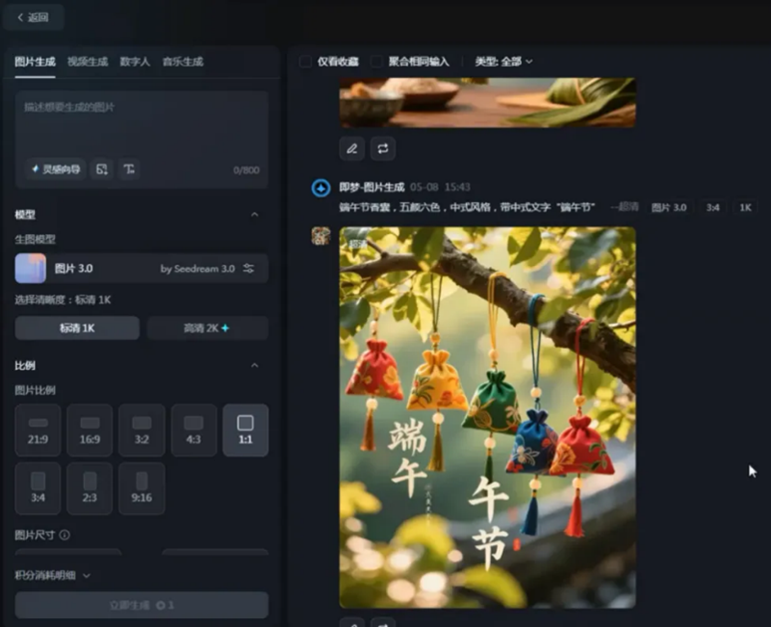
Image of the Dragon Boat Festival sachet involved in the case
In May 2025, a non-party used an AI image generation model to create an image of a Dragon Boat Festival sachet, only setting a 1:1 ratio and 1K resolution, and inputting prompts concerning the Dragon Boat Festival sachet, colors and Chinese style, and subsequently used Photoshop to delete the repeated text at the bottom of the image. The non-party then assigned the economic rights in the image to the plaintiff and completed work registration. After a kindergarten in Changsha used the image on its WeChat official account, the plaintiff filed suit on the grounds of infringement of the right of communication through information networks, claiming RMB 10,000 in economic losses and enforcement expenses.
The Kaifu District People’s Court of Changsha held that, in determining whether AI-generated output constitutes a work, the key lies not in whether artificial intelligence tools are used, but in whether the generation process reflects a natural person’s original intellectual input. In this regard, review may be conducted at three levels: front-end conception, generation control and back-end processing; among these, the generation control stage should focus on whether the control behavior directly targets specific expressions, whether the prompts correspond to the final image, and whether the user’s choices occupy a dominant position.
In this case, the prompts only set out general requirements regarding the object of generation, subject matter, colors and style, without making individualized choices concerning specific expressions such as the sachet’s shape, image composition, arrangement of elements and gradation of light and shadow, and the image ratio and resolution were merely general technical parameters. The subsequent deletion of repeated text was only a technical correction and did not form new original expression. Therefore, the court found that the AI-generated image in question does not constitute a work within the meaning of the Copyright Law, and ultimately dismissed all of the plaintiff’s claims. Neither party appealed, and the judgment has now taken legal effect.
Source: Kaifu District People’s Court of Changsha
News
Source: Ministry of Culture and Tourism
Source: National Copyright Administration
Source: National Radio and Television Administration
Source: China Intellectual Property News
Source: Phoenix Entertainment
Team China wins gold medals in the first two esports events in which it participates at the 2026 Aichi–Nagoya Asian Games: it defeats Team Thailand 3:0 in the finals of “Naraka: Bladepoint,” winning the first Asian Games gold medal in that event; it defeats Team Malaysia 4:0 in the finals of “Honor of Kings,” successfully defending its title
Source: Xinhua News Agency, CCTV.com
Cases
Source: Hangzhou Intermediate People’s Court