Key Focus
-
The Cyberspace Administration of China has launched a special campaign titled “Clean and Bright: Rectification of Chaos in False Personas in Short Videos” — with a focus on rectifying infringing and unlawful acts such as using AI-synthesized fake audio and video to impersonate public figures for false endorsements and marketing, strictly investigating acts of mass production through MCN agencies, multi-account matrix distribution and cross-platform re-posting of related content, and requiring platforms to strengthen content review and standardized labelling, and prohibiting the use of labels such as “AI-generated” to evade governance responsibilities.
-
The Hainan Free Trade Port Intellectual Property Court has concluded a copyright infringement case involving the adaptation of an online novel into a micro-short drama — clarifying that similarity at the level of ideas such as themes and character types does not constitute substantial similarity, but where specific expressions such as character settings, character relationships, plot development and dialogue are highly overlapping, infringement may be found; the court ordered the defendants to bear liability for damages, with the highest amount of damages awarded reaching RMB 350,000.
-
The Legal Department of miHoYo has published the result of the second-instance trial in the offline testing leak case of “Genshin Impact” — the court found that the tester breached his confidentiality obligations by providing undisclosed testing information such as unreleased characters and events to overseas leakers, thereby constituting infringement of trade secrets; the appeal was dismissed at second instance, and the judgment ordering cessation of infringement and payment of RMB 500,000 in economic losses and reasonable expenses was upheld.
News
- The Ministry of Culture and Tourism has issued the “Art Development ‘Fifteen-Five’ Plan”: it proposes exploring the establishment of a national platform for the development of copyright in theatrical scripts, promoting the application of technologies such as artificial intelligence and virtual reality in the fields of artistic creation and dissemination, popularizing online performances and cloud-based dissemination, and studying the establishment of mechanisms for the management, monitoring and early warning, and handling of artistic creation involving artificial intelligence.
- The National Press and Publication Administration: In September 2026, a total of 209 online games were granted publication numbers, including 206 domestically produced games and 3 imported games; as of the end of September 2026, the number of game publication numbers issued reached 1,571, representing a year-on-year increase of approximately 23.3%; among these, publication numbers for domestic games increased to 1,525, a year-on-year increase of approximately 27.6%.
- The China Film Administration has released data on the National Day holiday film market in 2026: nationwide box office revenue reached RMB 1.165 billion, with daily box office exceeding RMB 100 million for seven consecutive days, and total admissions reaching 31.9959 million; “Detective: Traces”, “What Do You Mean Couple”, “Resident Evil: Outbreak Night”, “Welcome to Long Restaurant”, and “Peppa Pig: Perfect Holiday” ranked in the top five at the box office.
- WeChat, Douyin and Kuaishou have strengthened governance of “AI rework” videos: in September 2026, the three platforms collectively removed 7,436 non-compliant videos, focusing on rectifying acts of malicious tampering, vulgar deconstruction and unlawful adaptation of classic films, television dramas and animated works using AI technology.
- China Animation Group and nine other institutions have jointly issued the “Joint Initiative on the Development of the Anime Carnival (Comic Convention) Industry”: it proposes strengthening intellectual property protection and review of exhibited and sold goods, resisting piracy and infringement, advocating licensed cooperation, and implementing measures for the protection of minors, guidance on rational consumption, and the overseas expansion of Chinese animation.
- The 19th China International Comics Festival was held in Guangzhou: it brought together thousands of domestic and foreign IPs and numerous animation and game brands, with the main venue attracting a cumulative attendance of over 450,000; concurrently, the 23rd Golden Dragon Award was held, and linkage was established with more than 30 core commercial districts and over 300 merchants in Guangzhou, thereby promoting consumption growth in animation and games, ACGN cultural and creative products, and IP derivatives.
- Composer Xu Jingqing has publicly defended his rights in relation to the unauthorized adaptation of classic music from “Journey to the West”: “Spark Society” was accused of adapting “Five Hundred Years of Mulberry Fields and Seas” and “Daughter’s Love” without authorization, altering the melody, lyrics and titles of the works and removing the original author’s attribution, and subsequently issued an apology statement and deleted the relevant videos.
Cases
-
The Tianjin Heping District People’s Court has concluded the court’s first copyright infringement case involving the adaptation of a written work into an AI comic drama: without permission, the defendant imported another’s complete written work into an AI tool to generate and disseminate an AI comic drama that was substantially similar, thereby infringing the right of adaptation and the right of communication through information networks; following mediation, the parties reached a settlement under which the defendant deleted the infringing content, ceased dissemination, and compensated for economic losses and reasonable expenses.
Key Focus
The Cyberspace Administration of China launches a special rectification campaign targeting false personas in short videos: focusing on cracking down on the use of AI to impersonate public figures for false endorsements and marketing, and strengthening platform content review, labelling and recommendation management
The Cyberspace Administration of China has deployed a two-month nationwide special campaign titled “Clean and Bright: Rectification of Chaos in False Personas in Short Videos”, focusing on rectifying five categories of issues: impersonating vulnerable groups, fabricating professional qualifications, using AI and other technologies to imitate persons, promoting extravagance and superstition, and fabricating conflict plots, while strengthening full-chain governance of accounts, MCN agencies and platforms. The core elements are as follows:
Rectifying the use of AI to imitate persons and false endorsements: focusing on cracking down on infringing and unlawful acts such as using AI-synthesized fake audio and video to impersonate public figures for false endorsements and marketing; at the same time, rectifying acts such as impersonating parties or relatives involved in social hotspot events, re-posting content to operate “shadow accounts”, and implying authorization from public figures through account names, profiles or re-posted videos.
Strictly investigating and punishing accounts, MCN agencies and platforms: lawfully and strictly cracking down on acts of malicious marketing and profit-making through false personas that mislead internet users, as well as acts of mass-producing homogeneous false persona content through MCN agencies, multi-account matrix distribution and cross-platform re-posting and dissemination; accounts of a particularly egregious nature will be banned.
Strengthening content review and standardized labelling: platforms shall perform their content review obligations and strictly deal with false persona short videos that are not labelled as required; they shall not evade requirements for governance of the online ecosystem on the grounds that the content has been labelled as “fictional performance”, “AI-generated”, “marketing”, “repost” or “personal opinion”, or accompanied by a statement that there is no improper guidance.
Strengthening recommendation management and qualification review: it is strictly prohibited to push false persona short videos in rankings, recommendation slots and other positions, and professional qualification review shall be strengthened; content involving the false creation of personas such as “AI domineering CEO”, impersonation of professionals to mislead internet users, and the use of false “assisting farmers” personas for sales shall be strictly dealt with in accordance with laws and regulations.
Source: Cyberspace Administration of China
The Hainan Free Trade Port Intellectual Property Court concludes a copyright infringement case involving the adaptation of an online novel into a micro-short drama
Since February 2024, author An has serialized the novel “Imperial Uncle” on “Qimao Chinese Online”. Qimao subsequently obtained an exclusive license to all copyrights in the novel other than the right of attribution, and authorized Dian Company to adapt it into a micro-short drama. In November 2024, the short drama “Prince” was released online, with cumulative views reaching 35.966 million on Douyin and 13.042 million on Kuaishou. Qimao and Dian considered that the short drama plagiarized the character settings, plot development and dialogue expressions of the novel “Imperial Uncle”, and therefore brought an action against nine companies including the producer of the short drama and the dissemination platforms, claiming RMB 5 million in damages. The defendants argued that the short drama was adapted from another novel, “Xuanmen”, and contended that “Imperial Uncle” itself plagiarized prior works and lacked originality.
The Hainan Free Trade Port Intellectual Property Court held that although “Imperial Uncle” and the prior works both contain character settings and plots such as the female protagonist travelling through time, the male protagonist being terminally ill, and the female protagonist treating the male protagonist, their specific expressions are clearly different, and similarity at the level of ideas does not constitute substantial similarity within the meaning of copyright law; the novel is original. The creation and release of the short drama “Prince” occurred later than the serialization of “Imperial Uncle”, and the defendants had the possibility of accessing the novel; the two works are highly similar in specific expressions such as character settings, character relationships, plot development, dialogue, narration and plot progression, and the relevant similar content cannot be found in the alleged source of adaptation, “Xuanmen”, as claimed by the defendants. Therefore, the court found that “Prince” and “Imperial Uncle” are substantially similar, and that the relevant unauthorized uses infringed the right of adaptation, the right of cinematography and the right of communication through information networks.
The court determined the liabilities of each defendant separately based on the specific acts committed and the types of rights infringed: the defendants who carried out the adaptation and cinematography acts were ordered to compensate the two plaintiffs RMB 100,000, and the defendants who carried out acts of communication through information networks were ordered to compensate RMB 350,000, while certain operating platforms were held jointly and severally liable for infringement of the right of communication through information networks in amounts ranging from RMB 10,000 to RMB 180,000.
Source: Hainan Free Trade Port Intellectual Property Court
Second-instance conclusion of the “Genshin Impact” offline testing leak case: tester’s disclosure of undisclosed testing information to overseas recipients constitutes trade secret infringement
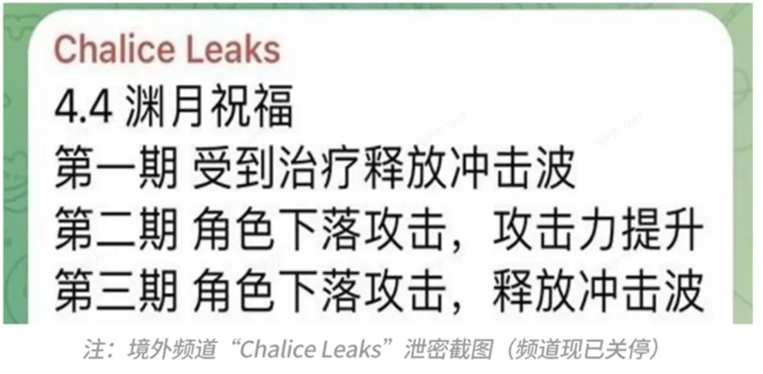
Note: Screenshot of leaks from the overseas channel “Chalice Leaks” (channel has now been closed)
According to information published by the Legal Department of miHoYo, Jin, after signing a confidentiality agreement, was invited to participate in offline testing of “Genshin Impact”. The agreement expressly stipulated that testers shall not copy or retain confidential information obtained during testing, nor disclose such information to any third party. Jin nevertheless used his mobile phone to photograph unreleased game content and provided images containing information on unreleased characters and events to overseas leaker “Oaemin”. The relevant content was subsequently posted to an overseas platform account operated by “Oaemin”.
The court found that the undisclosed testing information at issue was not known to the public, had commercial value, and that miHoYo had adopted confidentiality measures, thereby constituting trade secrets. Jin breached his confidentiality obligations and disclosed the relevant information to overseas individuals, thereby infringing miHoYo’s trade secrets. The court of first instance ordered Jin to cease the infringement and to compensate miHoYo RMB 500,000 in economic losses and reasonable expenses. Jin appealed, but the court of second instance dismissed the appeal and upheld the original judgment.
In addition, “Oaemin” had repeatedly induced and instigated Jin to purchase covert recording equipment, and had extracted confidential information by requiring Jin to memorize testing content; after receiving covertly taken photographs of the unreleased character “Fujin” from Jin, “Oaemin” processed the photos using AI and reposted them. After the controller of the relevant account was located, miHoYo filed a separate lawsuit against him, which is currently still pending.
Source: Legal Department of miHoYo
News
Source: Ministry of Culture and Tourism
National Press and Publication Administration: In September 2026, a total of 209 online games were granted publication numbers, including 206 domestically produced games and 3 imported games; as of the end of September 2026, the number of game publication numbers issued reached 1,571, representing a year-on-year increase of approximately 23.3%; among these, publication numbers for domestic games increased to 1,525, a year-on-year increase of approximately 27.6%
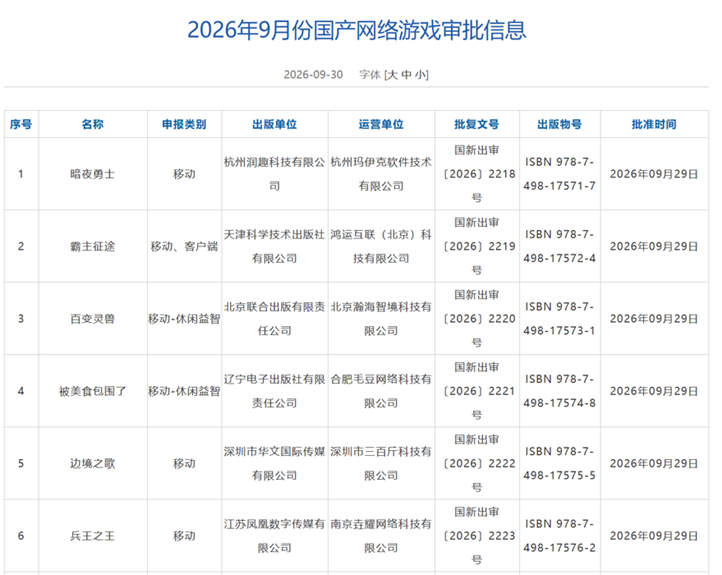
Image source: National Press and Publication Administration
Source: National Press and Publication Administration

Image source: Xinhua News Agency
Source: Xinhua News Agency
Source: Jiemian News
Source: China Intellectual Property News Information Network
Source: People’s Daily
Source: China Intellectual Property News
Cases
Source: Tianjin Heping District People’s Court