
Key Focus
The Cyberspace Administration of China and four other departments jointly issued the Provisions on the Administration of Multi-channel Distribution Services for Online Information Content — requiring MCN institutions to complete registration of their business entities in accordance with the law; prohibiting MCN institutions from engaging in acts that disrupt the order of the internet such as confusing the public, misleading the public, fabricating fake traffic, or conducting misleading marketing.
The National Copyright Administration and three other departments launched the “Sword Net 2026” Special Campaign — focusing on copyright protection in the fields of film and television dramas, cultural and creative products, books and AI, and cracking down on illegal acts such as intentionally providing assistance for the dissemination of pirated film and television resources, counterfeiting well-known IP, false IP co-branding, and using AI to carry out “AI re-creation,” “content laundering,” deepfakes and other unlawful activities.
The Beijing Internet Court issued the Beijing Internet Court White Paper on Online Judicial Protection of Minors (2021–2026) — over the past five years, the number of cases involving online disputes related to minors accepted by the court has increased nearly twentyfold; disputes over refunds arising from game top-ups and live-streaming rewards occur frequently, with the highest amount in a single live-streaming reward case exceeding RMB 6.5 million, and the highest amount in a single game top-up case exceeding RMB 640,000.
The Guangzhou Internet Court released ten typical cases on online judicial protection of minors — clarifying that where there are loopholes in the anti-addiction system of a gaming platform, the platform shall bear a larger proportion of the refund liability for minors’ top-ups; where a minor “doxxes” others online to vent anger and thereby commits an infringement, the guardian shall bear liability for compensation.
News
The National Copyright Administration issued the seventh batch of the 2026 Early Warning List for Key Works Copyright Protection (TV dramas), covering 17 TV drama works including Liang Chen Mei Jin and Blazing Summer.
The National Radio and Television Administration announced the special results for “AI re-creation” videos in May 2026: more than 8,000 non-compliant videos and various cult-like animations based on classic film and television works such as the Four Great Classical Novels, historical themes, revolutionary themes, and heroic role models that had undergone “AI re-creation” were removed, and more than 20 non-compliant accounts were dealt with.
The National Radio and Television Administration announced the results of the intensive rectification of infringing dissemination of TV dramas (online dramas) from 22 to 31 May: the offline rate of infringing dissemination links within four hours reached 100%, with more than 1.37 million infringing and pirated complaint links handled and removed in total, and 301 accounts dealt with.
China Media Group issued the Statement on Media Rights Marketing and Investment Promotion for the 2026 FIFA World Cup in the United States, Canada and Mexico: clarifying that the General Manager’s Office of CMG is the sole department in charge of the centralized management of copyright and advertising investment promotion, and that any institution or individual must enter into a license agreement with this office before carrying out relevant cooperation; without authorization, no entity may conduct investment promotion, publicity or covert marketing in the name of event rights or advertising resources.
The Shanghai Municipal Administration of Culture and Tourism issued Several Measures of Shanghai Municipality on Accelerating the High-quality Development of Micro-short Dramas Empowered by Artificial Intelligence: providing support of up to RMB 10 million for eligible self-developed intelligent agent projects; a micro-short drama “going global” base will be established in Pudong New Area, and micro-short drama works will be promoted overseas by leveraging film and television festivals and exhibitions such as the Shanghai TV Festival.
The 2026 summer box office has exceeded RMB 100 million; as of 2 June, the box office of the film A Letter to Grandma has exceeded RMB 1.46 billion, temporarily ranking second in the 2026 annual box office.
Cases
The Hangzhou Internet Court concluded a dispute over online game top-ups in which a minor used a relative’s identity to evade anti-addiction supervision: even where the guardian is clearly at fault, if the gaming platform only adopts basic real-name authentication and fails to take technical prevention and control measures such as facial recognition, early warning for high-frequency small-amount top-ups, and secondary verification of abnormal consumption, it shall still bear 30% of the refund liability.
The public security authorities in Yueyang, Hunan cracked a case involving the establishment of private servers for pirated games: the criminal suspects formed a team to develop and operate two online games highly similar to Fantasy Westward Journey and illegally profited through player top-ups, with the amount involved exceeding RMB 6 million, suspected of the crime of copyright infringement.
Key Focus
The Cyberspace Administration of China, the National Radio and Television Administration and Three Other Departments Jointly Issued the Provisions on the Administration of Multi-channel Distribution Services for Online Information Content
The Provisions clarify that “multi-channel distribution services for online information content” refers to “services such as planning, production, distribution, marketing, promotion and brokerage provided for the information content production and publication activities of public accounts of internet users”, and at the same time stipulate the respective obligations to be performed by institutions providing multi-channel distribution services for online information content (hereinafter “MCN institutions”) and platform information service providers (hereinafter “platforms”). The Provisions will come into force on 1 September 2026, with the core contents including:
Clarifying the access and compliance operation requirements for MCN institutions: MCN institutions shall complete registration of their business entities in accordance with the law, and their business scope shall include the expression “multi-channel distribution services for online information content”; relevant institutions that have already completed registration shall, within 30 days from the date of implementation of the Provisions, complete the registration of changes to their business scope. Where MCN institutions engage in internet cultural activities, online performance brokerage, online publishing, online audio-visual programs, internet news information services and other businesses, they shall also obtain the corresponding administrative licenses in accordance with the law. MCN institutions shall also establish a person in charge of information content management, equip a content management team commensurate with the scale of their business, and formulate internal rules such as those on information content management.
Strengthening platforms’ obligations for admission review and filing of MCN institutions: platforms shall enter into admission agreements with MCN institutions seeking to join, and verify whether they meet the requirements on business entity registration, administrative licensing and content management; where the requirements are not met, the platform shall not agree to their admission or provide corresponding services. After an MCN institution is admitted, the platform shall, within 30 working days, report the admission to the provincial-level cyberspace administration at its place of registration for filing; where the filing information changes, the platform shall also complete the filing of changes within 30 working days.
Clarifying the prohibition on MCN institutions disrupting online order or seeking improper benefits: the Provisions explicitly prohibit MCN institutions and their contracted accounts from engaging in various illegal and non-compliant acts, including misleading the public through synthesis and forgery, speculation and fabrication, patching and editing, inciting online users’ emotions, provoking group antagonism, fabricating personas or plots for false marketing, fabricating traffic or publishing homogeneous content in bulk, hyping social hotspots, emergencies and disaster accidents, organizing or assisting online bullying, and disseminating undesirable values.
Emphasizing the protection of minors and compliance in live-streaming marketing: where MCN institutions provide services to minors, they shall perform their obligations for online protection of minors in accordance with the law; they shall not provide services related to online live-streaming publication to minors under the age of sixteen. Where services are provided to minors who have reached the age of sixteen, identity information shall be verified and the consent of their parents or other guardians shall be obtained. For online live-streaming marketing activities, MCN institutions and operators of contracted accounts shall establish mechanisms for live-streaming product selection, error correction, compliance review and handling of unlawful acts.
Establishing mechanisms for handling violations and reporting between MCN institutions and platforms: where MCN institutions discover that their contracted accounts violate laws and regulations, platform rules or service agreements, they shall take measures such as issuing warnings and reminders, suspending services, or terminating agreements, and notify the platform. Where platforms discover that MCN institutions have not entered into admission agreements or are involved in illegal or non-compliant circumstances, they may take measures against such institutions and their contracted accounts such as issuing warnings and reminders, ordering rectification within a time limit, restricting account functions, suspending monetization rights, restricting services, closing accounts, terminating admission, and including them on platform blacklists; where account closure, termination of admission or inclusion on a blacklist is involved, the platform shall report to the provincial-level cyberspace administration at its place of registration and relevant departments, and where a crime is suspected, it shall promptly report the case to the public security authorities.
Clarifying supervision and inspection mechanisms and legal liability: departments such as cyberspace administration, public security, culture and tourism, market regulation, radio and television, and press and publication will, according to their respective duties, conduct supervision and inspection of MCN institutions, and platforms and MCN institutions shall cooperate. Violations of the Provisions shall be handled in accordance with the Cybersecurity Law, the Law on the Protection of Minors, the Administrative Measures for Internet Information Services and other laws and regulations; where relevant laws and regulations do not provide for such violations, the competent departments may give warnings, circulate criticisms, or order rectification within a time limit, and may also impose a fine of not less than RMB 10,000 but not more than RMB 100,000; where the circumstances involve endangering the life and health of citizens and cause serious consequences, a concurrent fine of not less than RMB 100,000 but not more than RMB 200,000 may be imposed.
Source: Cyberspace Administration of China
The National Copyright Administration and Three Other Departments Launched the “Sword Net 2026” Special Campaign
This special campaign is the 22nd special rectification action jointly carried out by the National Copyright Administration, the Ministry of Industry and Information Technology, the Ministry of Public Security and the Cyberspace Administration of China, focusing on key works and key online platforms, and focusing on the following four key areas:
Copyright protection for film and television dramas: rectifying illegal acts such as online service platforms such as network disks, browsers and search engines proactively providing pirated film and television resources and related services, intentionally providing assistance for the dissemination of pirated film and television resources, facilitating film and television piracy for the purpose of traffic diversion, directly porting, cutting, segmenting, adapting and compiling film and television works without authorization and disseminating them online, disseminating or selling pirated film and television resources by means of live-streaming, paid search, or traffic diversion, and committing infringement and piracy through streaming intelligent terminals such as TV set-top boxes.
Copyright protection for cultural and creative products: rectifying illegal acts in the cultural and creative field such as homogeneous plagiarism, copycat imitation, false copyright registration, counterfeiting well-known IP, false IP co-branding, forging authorization to produce cultural and creative products and selling them through online and offline channels such as live-streaming rooms, e-commerce stores, cultural tourism attractions, and areas surrounding campuses, and addressing issues such as blockages in the copyright licensing chain and unclear rights management.
Copyright protection for books: focusing on rectifying piracy of bestsellers, evergreen titles, children’s books, textbooks and teaching aids, continuously cracking down on infringements such as selling pirated books, electronic book resources, and network disk account passwords storing electronic books through e-commerce, live-streaming, short video and other platforms, and focusing on investigating and punishing illegal acts such as “on-demand pirated printing,” mixing genuine and fake products, malicious cross-regional distribution, and online traffic diversion to sell pirated books and electronic book resources.
Copyright rectification in the field of artificial intelligence: promoting the resolution of issues concerning the copyright compliance of training corpora for large models, and focusing on investigating and punishing acts of using artificial intelligence and other new technological tools to illegally reproduce, adapt and disseminate works, and, without authorization, carrying out “AI re-creation,” “content laundering,” deepfakes, evasion of monitoring and other infringing and unlawful acts in respect of works.
Source: National Copyright Administration
The Beijing Internet Court Issued the Beijing Internet Court White Paper on Online Judicial Protection of Minors (2021–2026)
According to the data in the White Paper, from May 2021 to May 2026, the Beijing Internet Court accepted a total of 2,581 cases involving online disputes related to minors, with the annual number of cases rising from 50 in 2021 to 997 in 2025, an increase of nearly twentyfold and an average annual growth rate of 111.3%; the types of cases are highly concentrated, with disputes over online service contracts accounting for 86.4%, mainly refund disputes arising from game top-ups and live-streaming rewards, with the highest amount in a single live-streaming reward case exceeding RMB 6.5 million, and the highest amount in a single game top-up case exceeding RMB 640,000; some minors topped up hundreds of thousands of yuan within a short period in lottery mini-games and blind box consumption.
The Beijing Internet Court simultaneously released 12 typical cases on online judicial protection of minors, many of which relate to the pre-review and interim handling obligations of online service providers, online “doxxing” of minors, game top-ups, live-streaming refunds, and short video account bans, including in particular:
Case 1: Wang Xiaomou v. a Network Technology Company — dispute over an online service contract — the contract is invalid where an online service provider provides minors with cultural products that violate public order and good morals.
Case 4: Cheng Xiaomou v. a Technology Company — dispute over online tort liability — where an online service provider fails to promptly handle online information content that obviously infringes upon minors, it shall bear joint and several liability.
Case 6: Zhou Xiaomou v. Wang Mou — dispute over online tort liability — the act of exposing a minor’s personal information shall bear tort liability in accordance with the law.
Case 8: Zhang Xiaomou v. a Game Company — dispute over an online service contract — where a gaming platform fails to effectively implement a real-name authentication mechanism for minors, it shall bear liability.
Case 9: Liu Xiaomou v. a Technology Company — dispute over an online service contract — where a live-streaming platform fails to exercise due prudence in reviewing the lifting of consumption restrictions on a minor’s account, it shall bear liability.
Case 10: Li Moumou v. a Technology Company and others — dispute over an online service contract — where a guardian fails to properly supervise and manage a minor child’s online consumption behavior, the guardian shall bear liability.
Case 11: Chen Mou v. a Technology Company in Beijing — dispute over an online service contract — where a guardian condones or cooperates with a minor in making large top-up rewards, such conduct constitutes implied consent to the minor’s rewards.
Case 12: Zheng Moumou v. a Technology Company — dispute over an online service contract — online service providers have the obligation, based on algorithms, to take management measures such as account bans against acts that infringe upon the rights and interests of minors.
Source: Beijing Internet Court
The Guangzhou Internet Court Released Ten Typical Cases on Online Judicial Protection of Minors
The typical cases released this time cover topics such as copyright protection for minors’ written works, the appropriateness of platforms’ account bans, allocation of liability for infringement arising from minors’ online “doxxing,” and allocation of liability for refunds of game top-ups, including the following cases:
Case 2: Wang Moumou v. Yang Moumou, a Cultural Company and a Media Company — dispute over copyright infringement — a short essay with originality is protected by the Copyright Law, and where “content laundering” is carried out and no evidence is provided, the infringer shall bear liability for infringement.
Case 3: Gao Moumou v. a Technology Company — dispute over an online service contract — where an adult player posts pornographic remarks in a game frequented by minors, the platform’s account ban in accordance with the contract is reasonable and appropriate.
Case 5: Wang Mou v. Zhang Mou, Zhao Mou and others — dispute over online tort liability — where a minor “doxxes” others online to vent anger and thereby commits an infringement, the guardian shall bear liability for compensation.
Case 8: Qiu Mou v. a Technology Company — dispute over an online service contract — where there are loopholes in the anti-addiction system of a gaming platform, the platform shall bear a larger proportion of the refund liability for minors’ top-ups.
Case 9: Du Moumou v. a Technology Company — dispute over an online service contract — channel cooperation does not exempt game operators from their anti-addiction obligations towards minors.
Case 10: Chen Mou v. a Technology Company — dispute over an online service contract — where a guardian promises not to apply for a refund and later reneges and files a lawsuit, such claim shall not be supported under the doctrine of promissory estoppel.
Source: Guangzhou Internet Court
Other News
The National Copyright Administration Issued the Seventh Batch of the 2026 Early Warning List for Key Works Copyright Protection (TV Dramas), Covering 17 TV Drama Works Including Liang Chen Mei Jin and Blazing Summer
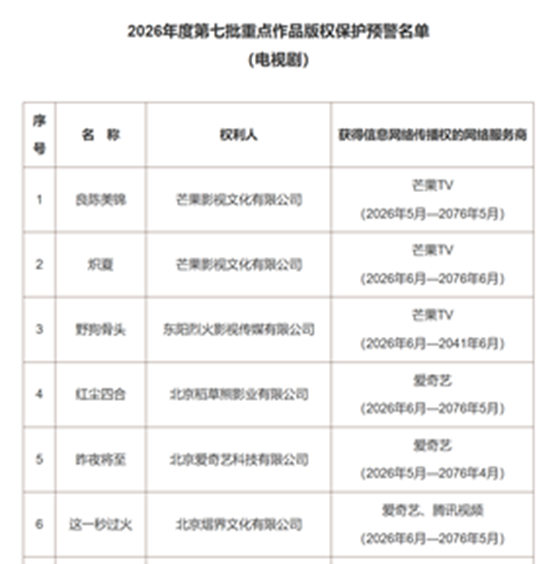
Image source: National Copyright Administration
Source: National Copyright Administration
The National Radio and Television Administration Announced the Special Results for “AI Re-creation” Videos in May 2026: More Than 8,000 Non-compliant Videos and Various Cult-like Animations Based on Classic Film and Television Works Such as the Four Great Classical Novels, Historical Themes, Revolutionary Themes and Heroic Role Models That Had Undergone “AI Re-creation” Were Removed, and More Than 20 Non-compliant Accounts Were Dealt With
Source: CNR News
The National Radio and Television Administration Announced the Results of the Intensive Rectification of Infringing Dissemination of TV Dramas (Online Dramas) from 22 to 31 May: the Offline Rate of Infringing Dissemination Links Within Four Hours Reached 100%, with More Than 1.37 Million Infringing and Pirated Complaint Links Handled and Removed in Total, and 301 Accounts Dealt With
Source: China Television Drama Production Industry Association
China Media Group Issued the Statement on Media Rights Marketing and Investment Promotion for the 2026 FIFA World Cup in the United States, Canada and Mexico: Clarifying That the General Manager’s Office of CMG Is the Sole Department in Charge of the Centralized Management of Copyright and Advertising Investment Promotion, and That Any Institution or Individual Must Enter into a License Agreement with This Office Before Carrying Out Relevant Cooperation; Without Authorization, No Entity May Conduct Investment Promotion, Publicity or Covert Marketing in the Name of Event Rights or Advertising Resources
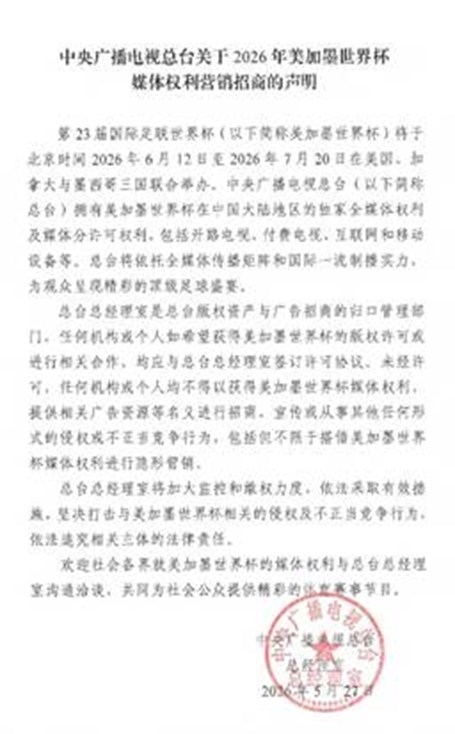
Image source: CCTV News
Source: CCTV News
The Shanghai Municipal Administration of Culture and Tourism Issued Several Measures of Shanghai Municipality on Accelerating the High-quality Development of Micro-short Dramas Empowered by Artificial Intelligence: Providing Support of up to RMB 10 Million for Eligible Self-developed Intelligent Agent Projects; a Micro-short Drama “Going Global” Base Will Be Established in Pudong New Area, and Micro-short Drama Works Will Be Promoted Overseas by Leveraging Film and Television Festivals and Exhibitions Such as the Shanghai TV Festival
Source: Shanghai Municipal Administration of Culture and Tourism
The 2026 Summer Box Office Has Exceeded RMB 100 Million; as of 2 June, the Box Office of the Film A Letter to Grandma Has Exceeded RMB 1.46 Billion, Temporarily Ranking Second in the 2026 Annual Box Office
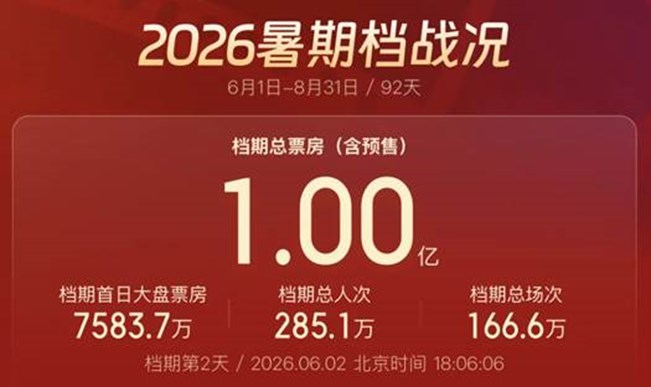
Image source: CCTV News
Source: CCTV News
Cases
The Hangzhou Internet Court Concluded a Dispute over Online Game Top-ups in Which a Minor Used a Relative’s Identity to Evade Anti-addiction Supervision: Even Where the Guardian Is Clearly at Fault, if the Gaming Platform Only Adopts Basic Real-name Authentication and Fails to Take Technical Prevention and Control Measures Such as Facial Recognition, Early Warning for High-frequency Small-amount Top-ups, and Secondary Verification of Abnormal Consumption, It Shall Still Bear 30% of the Refund Liability
Source: Cyberspace Administration of Zhejiang Province