
Key Focus
- Supreme People’s Court amends the “Interpretation on Several Issues Concerning the Application of Law in the Trial of Civil Dispute Cases Involving Copyright” — clarifies that making a work “available to the public” does not require actual awareness by the public as a constituent element, refines the boundaries of fair use of artistic works in public places, and provides that mutual reprinting of published works between newspapers and internet information service providers, and between internet information service providers, does not fall under the statutory license for newspaper reprinting
- Central Cyberspace Affairs Commission issues the “Action Plan for Promoting the High-Quality Development of Cybersecurity and Informatization Enterprises (2026–2030)” — by 2030, significantly enhance the overall strength of China’s cyber and information enterprises, and deploy seven actions including enterprise cultivation services, enhancement of innovation capabilities, empowerment of industrial upgrading, and expansion into overseas markets, while supporting high-quality creation in animation, games, film and television, music, and online literature
- Shanghai Pudong Court concludes a case involving infringement of trade secrets by a minor who cracked a game test version and disclosed update content — new characters, scenes and plots in the test version involved had not yet been made public, possessed commercial value, and the game operator had adopted confidentiality measures, thereby constituting business secrets protected by law; the minor obtained and cracked the test version software package through improper channels, released test videos and set up a private server for public use, and his guardian bears corresponding liability for compensation in accordance with law
News
- Central Cyberspace Administration of China: Since the launch of the special campaign “Clean and Bright: Rectification of Disorder in Network Entertainment Group Live Streaming”, more than 7,200 group live-streaming rooms in violation have been dealt with, and more than 2,200 non-compliant accounts have been severely punished. At the same time, platforms such as Douyin, Kuaishou, WeChat Video Accounts, Bilibili and Xiaohongshu have been guided to remove and dispose of a number of group live-streaming MCN institutions with serious problems, and 17 governance bulletins have been issued.
- Network Audiovisual Department of the National Radio and Television Administration issues a management reminder on micro-short dramas with “agriculture, rural areas and farmers” themes: encouraging and guiding the farmer community to actively participate in the creation of micro-short dramas, while requiring avoidance of flat and stereotyped portrayals of farmers, and prohibiting conceptualized and vulgar depictions of rural life.
- National Radio and Television Administration: In the first half of 2026, the total revenue of the national radio and television service industry reached RMB 751.389 billion, a year-on-year increase of 9.15%, of which the total revenue of radio and television institutions was RMB 324.760 billion, and the total revenue of online audiovisual service institutions was RMB 426.629 billion; as of the end of June, there were 205 million actual cable television users nationwide.
- Public Opinion Data Center of People.cn releases the “Insight into Online Hotspots of Domestic Film and Television Copyright in the First Half of 2026”: online discussions related to film and television copyright in the first half of the year focused on issues such as copyright protection for broadcasting major events, piracy and leakage of hit dramas, and governance of “AI radical modification”; as generative artificial intelligence accelerates its penetration into the production, dissemination and development of film and television content, copyright disputes have further extended to areas such as compliance of training data, AI-generated content, authorization of digital images and voices of artists, etc.
- As of 22 August, the total box office of films in 2026 (including presales) exceeded RMB 27 billion, of which the total box office of summer vacation films (including presales) exceeded RMB 11.2 billion. The summer vacation season has recorded daily box office exceeding RMB 100 million for 43 consecutive days, and both the number of moviegoers and the number of screenings during the summer vacation season have set new historical records.
- Game Working Committee: In July 2026, the actual sales revenue of China’s domestic game market was RMB 31.098 billion, representing a month-on-month increase of 3.55% and a year-on-year increase of 6.92%; the actual sales revenue of Chinese self-developed games in overseas markets was USD 2.012 billion, representing a month-on-month increase of 2.16% and a year-on-year increase of 18.86%.
- Xiaohongshu issues the “Governance Bulletin of Xiaohongshu on Cracking Down on Non-compliant AI Live Streaming”: focusing on cracking down on acts that use AI face-swapping, voice cloning, and digital humans disguised as celebrities, entrepreneurs, top influencers and other public figures to mislead users’ perception of identity; once verified, the relevant accounts will be shut down and subjected to a 12-hour suspension of live streaming, and more severe measures will be taken in serious cases.
- NetEase releases its second quarter and interim results report for 2026: in the first half of the year, net revenues reached RMB 60.7 billion, a year-on-year increase of 7%, of which net revenues from games and related value-added services increased by 8.3% year-on-year to RMB 50.7 billion, mainly driven by increased net revenues from self-developed games such as the “Fantasy Westward Journey” series and “Where Winds Meet”; net revenues from NetEase Cloud Music were RMB 4 billion, up 3.4% compared with the same period in 2025.
- Kuaishou releases its interim results report for 2026: in the first half of the year, revenues reached RMB 69.251 billion, a year-on-year increase of 2.4%, and operating profit was RMB 7.352 billion, a year-on-year decrease of 23%; the platform’s average monthly active users increased by 11.5% year-on-year to 797.3 million; in the second quarter, operating revenue of Koling AI exceeded RMB 850 million, representing a year-on-year increase of more than 200%.
- POP MART releases its interim results report for 2026: in the first half of the year, revenue reached RMB 17.17 billion, a year-on-year increase of 23.8%; profit for the period increased by 8.9% year-on-year to RMB 5.1 billion. Business growth was mainly driven by the continuous expansion of the IP matrix and growth in the plush product category, among which THE MONSTERS achieved revenue of RMB 4.45 billion, and revenue from TWINKLE TWINKLE increased by 580.6% year-on-year to RMB 2.65 billion; revenue from plush products increased by 60% year-on-year to RMB 9.82 billion.
- iQIYI releases its first half 2026 results report: total revenue in the first half of the year was RMB 12.513 billion, of which membership services revenue was RMB 8.214 billion, online advertising services revenue was RMB 2.487 billion, and content distribution revenue was RMB 1.040 billion; in the second quarter, iQIYI’s domestic market share in long-form dramas, films and children’s content all ranked first.
Cases
- Shanghai Intellectual Property Court concludes the nation’s first judicial sanction case involving malicious evidence collection using AI “hallucinations”: a company conducted high-frequency, concentrated targeted searches to induce a search engine AI system to establish an erroneous association between its registered trademark and the defendant’s promotion pages, and brought a trademark infringement action based on a fabricated infringement appearance; the court found that this constituted false evidence collection, fabrication of basic case facts and abuse of litigation rights, and imposed a fine of RMB 100,000.
Key Focus
Supreme People’s Court Amends the “Interpretation on Several Issues Concerning the Application of Law in the Trial of Civil Dispute Cases Involving Copyright”
This amendment further refines the criteria for determining publication of works, the boundaries of fair use, and the scope of statutory license for newspaper reprinting, among other standards for the application of copyright law:
- Improving the scope of acceptance of civil cases involving copyright disputes (Article 1): It clarifies that the people’s courts shall accept cases concerning ownership, infringement and contract disputes over copyright and rights related to copyright, including infringement disputes involving confirmation of non-infringement of copyright and rights related to copyright. At the same time, applications for pre-litigation cessation of infringement, pre-litigation preservation of property and preservation of evidence, as well as disputes over liability for damages arising from applications for cessation of infringement before or during litigation, are brought within the scope of acceptance.
- Supplementing the types of evidence in copyright cases (Article 6): Among materials that may serve as evidence in copyright cases, certifications issued by appraisal institutions are added. Drafts of works, originals, lawfully published works, copyright registration certificates, certifications issued by authentication or appraisal institutions, and contracts for acquisition of rights submitted by the parties may all serve as evidence.
- Clarifying the criteria for determining that a work is “made available to the public” (Article 8): The previous limitation in the judicial interpretation that “the copyright owner makes the work available to the public on his own or with the permission of the copyright owner” is deleted, and it is clarified that “made available to the public” means making the work available to an unspecified group of persons, and does not require actual awareness by the public as a constituent condition. Therefore, where a work is made available to the public as a result of another person’s infringing act, it also falls within “made available to the public”.
- Adjusting the applicable rules for mere factual information (Article 14): The previous provision in the judicial interpretation that “mere factual information disseminated through mass media constitutes current news” is deleted, and it is clarified that when disseminating and reporting mere factual information compiled by others, the source shall be indicated.
- Refining the rules on fair use of artistic works in public places (Article 16): The expression “artistic works in outdoor public places” in the previous judicial interpretation is amended to “artistic works in public places”, so as to align with the Copyright Law as revised in 2020, thereby extending the scope of application to public and commercial art galleries, exhibition halls and other venues. Where artistic works in public places are copied, painted, photographed or video-recorded, the resulting works may be further used in a reasonable manner and within a reasonable scope in accordance with law, but without the permission of the copyright owner, they may not be set up, displayed or disseminated to the public in the same manner.
- Clarifying the scope of application of statutory license for newspaper reprinting (Article 17): The “newspapers and periodicals” subject to statutory license are clarified as printed newspapers and periodicals approved for publication by the competent authorities, as well as digital versions consistent with their content and layout format. Where the layout of printed newspapers and periodicals is disseminated via information networks with its original content and layout format, statutory license for newspaper reprinting may be invoked.
- Clarifying that general online reprinting does not fall under statutory license for newspaper reprinting (Article 17): Mutual reprinting of published works between newspapers and internet information service providers, or mutual reprinting of published works between internet information service providers, does not fall under statutory license for newspaper reprinting, and permission from the copyright owner shall be obtained and remuneration paid. Except for digital versions consistent with the content and layout format of printed newspapers and periodicals, dissemination of newspaper and periodical content via information networks in other forms may not invoke such statutory license.
- Improving the rules on liability of publishers and computer software users (Articles 18 and 19): The “liability for damages” that publishers shall bear in the event of infringement by publications is adjusted to the broader civil liability. Users of computer software who use computer software for commercial purposes without permission or beyond the scope of permission shall also bear corresponding civil liability in accordance with law.
- Improving the rules for determining compensation for copyright infringement (Articles 23 and 24): Where it is difficult to calculate the actual losses of the right holder, the illegal gains of the infringer or reasonable royalties, the people’s court may, at the request of the parties or ex officio, apply statutory compensation. In determining the amount of compensation, the court shall comprehensively consider factors such as the type of work, the degree of fault of the alleged infringer, and the nature and consequences of the infringing act. Reasonable expenses incurred to stop the infringing act include reasonable costs incurred by the right holder or its entrusted agent in conducting investigation and evidence collection.
Source: Supreme People’s Court
Central Cyberspace Affairs Commission Issues the “Action Plan for Promoting the High-Quality Development of Cybersecurity and Informatization Enterprises (2026–2030)”
The Action Plan proposes that by 2030, the overall strength of China’s cyber and information enterprises will be significantly enhanced, and the institutional system for safe, regulated and orderly development will be further improved. The core points in the Action Plan related to empowering industrial upgrading, expanding overseas markets and safe and orderly development are as follows:
- Promoting digital transformation of industry (Items 8 to 11): Supporting cyber and information enterprises in providing digital solutions around the full-chain scenarios of the manufacturing industry, and in deploying industry foundation models, intelligent agents, industrial datasets, humanoid robots and smart factories; promoting the empowerment of agriculture, education, healthcare, radio and television audiovisual services, tourism and other fields by artificial intelligence, and facilitating the green and low-carbon development of computing power facilities.
- Expanding the supply of high-quality digital content (Item 10): Supporting enterprises in carrying out high-quality creation in the fields of animation, games, film and television, music and online literature, and using artificial intelligence and other technologies to create immersive, experiential and interactive digital consumption scenarios, thereby enhancing the supply of digital content consumption.
- Supporting cyber and information enterprises in orderly expansion into overseas markets (Item 12): Deepening international cooperation in areas such as digital infrastructure, artificial intelligence, e-commerce, mobile payment and digital transformation, supporting computing power, cloud services and artificial intelligence enterprises in “going global” in an orderly manner on the premise of risk prevention, and encouraging enterprises to participate in the formulation of international standards.
- Improving the compliance service system for enterprises going overseas (Item 13): Strengthening compliance guidelines for overseas operations, exploring the establishment of overseas business compliance guidance centers in key markets, establishing risk monitoring and early warning mechanisms and a case database of legal disputes involving cyber and information enterprises going overseas, and providing enterprises with legal services, compliance guidance and training.
- Strengthening cybersecurity, data security and algorithm governance (Item 14): Supporting enterprises in improving cybersecurity and data security protection systems, enhancing mechanisms for personal information protection, strengthening review of content recommended by algorithms and governance of abuse of artificial intelligence technologies, and imposing strict responsibilities on content service enterprises for content security management.
- Preventing disorderly competition and improving legal safeguards (Items 15 and 16): Strengthening anti-monopoly regulation in the cyber and information field, prohibiting disguised implementation of “choose one of two” and other acts that exclude or restrict competition, and regulating platform fees, excessive subsidies and “involution-type” competition; at the same time, advancing legislation in areas such as artificial intelligence, digital economy, online platforms and blockchain, and improving the institutional framework for internet information services and algorithm governance.
Source: Central Cyberspace Administration of China
Shanghai Pudong Court: Minor Cracking Game Test Version Software Package and Disclosing Update Content Constitutes Infringement of Trade Secrets; His Guardian Shall Bear Corresponding Liability for Compensation
A Shanghai network technology company is the operator of the online game “Honkai: Star Rail”. For version updates, prior to the official launch of a new version, the company recruited a small number of confidential test players, provided them with test version software packages for trial play and feedback, and entered into confidentiality agreements with the test players and issued notices prohibiting leakage. Since 2024, Yang has continuously posted videos of the test versions of the game involved via his personal social media accounts and provided multiple versions of the test version software packages for download by unspecified users. Investigation revealed that the relevant test version software packages were obtained and cracked by the minor Gu through improper channels; Gu also posted test videos on social media and set up a website with the nature of a private server to provide the operating environment of the test version game involved to the public. The company then brought an action against Yang, Gu and Gu’s guardian Dong before Shanghai Pudong Court, requesting that the three defendants be ordered to cease infringement of trade secrets, eliminate adverse impact, and compensate for economic losses and reasonable expenses in the amount of RMB 2 million.
Shanghai Pudong Court held that the new characters, new scenes and new plots in the test versions involved had not yet been displayed in the publicly available versions of the game, and were only provided on a time-limited basis to a small number of players selected for testing, thereby possessing secrecy; the relevant content constituted phased achievements formed through iteration of game versions, directly related to market popularity, player expectations and the operation cycle after the launch of the new version, and possessed commercial value; the game operator had adopted reasonable confidentiality measures by entering into confidentiality agreements and issuing notices prohibiting leakage. Therefore, the undisclosed content in the test versions of the game involved met the statutory requirements of “not known to the public, possessing commercial value, and subject to corresponding confidentiality measures taken by the right holder”, and constituted business secrets protected under the Anti-Unfair Competition Law.
The court further held that Yang and Gu were not confidential test players of the game involved and had no legitimate grounds to obtain the test version software packages. After obtaining the software packages through illegal channels, the two used technical means to crack and disclose them to the public, respectively constituting illegal acquisition and illegal disclosure of the business secrets of the game operator; Gu’s establishment of a private server and provision to the public of the operating environment for the test version game further expanded the scope of dissemination of the confidential content and aggravated the consequences of infringement. Given that Gu was a minor at the time of the alleged acts, his guardian Dong shall bear corresponding liability for infringement compensation in accordance with law. Ultimately, the court ordered Yang and Gu to immediately cease infringement of trade secrets, issue statements within a specified scope to eliminate adverse impact, and ordered Yang and Dong to be jointly and severally liable to compensate the game operator for economic losses and reasonable expenses totaling RMB 1 million. None of the parties appealed after the first-instance judgment, which has now become effective.
Source: Shanghai High People’s Court
News
Source: China Internet Information Office
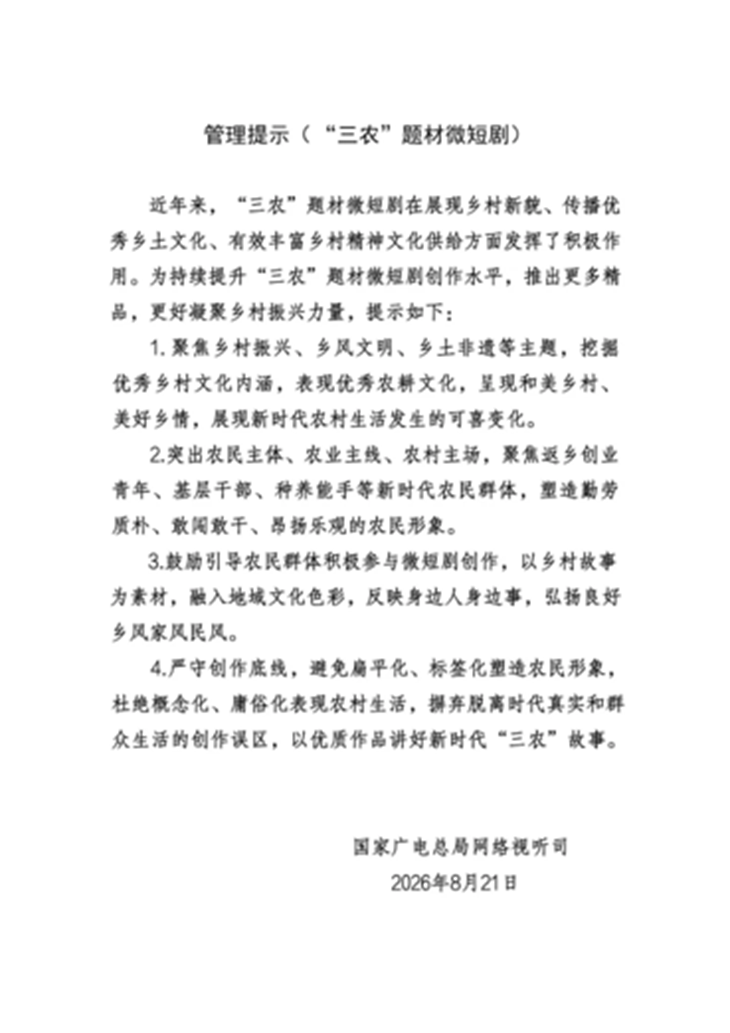
Image source: Radio and Television World
Source: Radio and Television World
Source: National Radio and Television Administration
Source: China Press, Publication, Radio and Television Journal; Public Opinion Data Center of People.cn

Image source: CCTV News
Source: Beijing Daily Website
Source: Game Working Committee of China Audio-Video and Digital Publishing Association
Source: Xiaohongshu “Shu Manager”
Source: NetEase Investor Relations
Source: Kuaishou Investor Relations
Source: POP MART Investor Relations
Source: iQIYI Investor Relations
Cases
Source: China Intellectual Property News