
Key Focus
- The Supreme People’s Court releases three typical cases on cyberspace rule of law concerning protection of personality rights and copyright — clarifying the factors for applying injunctions against infringement of personality rights in cyberbullying, the joint tort liability of the principal and the livestreamer in “counterfeit celebrity endorsement,” and that AI search engine service providers adopting retrieval-augmented generation technology may be exempt from liability after promptly handling infringing links
- The State Administration for Market Regulation publishes six typical cases of illegal blind box operations — in one case, the infringer sold card blind boxes and figurine blind boxes bearing counterfeit registered trademarks such as “Sanrio,” “Ultraman,” and “Demon Slayer” via a Taobao online store and offline wholesale channels, with an illegal business turnover exceeding RMB 248,000; the illegal gains were confiscated and a fine of RMB 610,000 was imposed
- Shanghai Pudong Court concludes Shanghai’s first unfair competition case involving AI voice imitation — the commercial use of 59 voice resource packs of characters from “Genshin Impact” constitutes copyright infringement; the relevant character names, lines, images and exclusive voices may also be protected as components of commercial identifiers with certain influence; the defendant is ordered to cease infringement and pay RMB 750,000 in damages
- Beijing Tongzhou People’s Procuratorate handles a criminal case involving foreign-related music copyright — by restoring deleted data, the procuratorial organ identified the actual operator and, using International Standard Recording Codes to reinforce ownership evidence for more than 600 foreign songs, increased the amount of illegal business from over RMB 700,000 to over RMB 1.1 million; the two defendants were found guilty of the crime of copyright infringement and the crime of harboring, respectively
News
- The Ministry of Industry and Information Technology, the Ministry of Commerce, the Ministry of Culture and Tourism and three other departments jointly issue the Opinions on Promoting High-Quality Development of the Historical Classics Industry: proposing to promote deep integration of “historical classics + culture,” encouraging the creation of films and TV dramas, literature, music, animation, performing arts, games, documentaries and other works themed on the historical classics industry; strengthening publicity and promotion of classic famous products, and building outbound brands that combine cultural roots with global appeal
- The 2025–2026 China Publishing Industry Development Report is released: in 2025, China’s digital publishing industry generated revenue of nearly RMB 1.88 trillion, a year-on-year increase of 7.51%; the online literature reading market reached RMB 50.21 billion, the IP adaptation market reached RMB 367.61 billion, and overseas revenue from online literature reached RMB 5.64 billion, a year-on-year increase of 11.2%, with nearly 200 million active overseas users across more than 200 countries and regions
- As of July 2026, Hongguo short dramas had 168 million daily active users, a year-on-year increase of 107%, exceeding the combined daily active users of the four major long-video platforms iQIYI, Youku, Tencent Video and Mango TV; the “free viewing + advertising revenue sharing” model and ByteDance’s algorithmic recommendation capabilities have driven rapid platform growth; more than 200 new drama series are launched daily, AI short drama production costs are 70% to 90% lower than traditional live-action short dramas, and production cycles can be shortened from one to two months to a few days
- Sensor Tower: in August 2026, a total of 38 Chinese mobile game publishers ranked among the global top 100 mobile game publishers by revenue, with combined revenue of USD 2.2 billion, accounting for 41.8% of the total revenue of the global top 100 mobile game publishers; Tencent’s “Game for Peace” saw an 18% month-on-month revenue increase in August, and since its launch in 2019, its cumulative revenue on the Chinese mainland iOS platform has exceeded USD 8 billion
- Tencent’s “Delta Force: Hawk Ops,” “DreamStar,” and eight other games launch collaborations with the Imperial Kiln Museum in Jingdezhen: through gameplay, digital collectibles, cultural co-creation and public welfare activities, they present ceramic patterns, porcelain-making techniques and collection artifacts; the series of activities attracted more than 60 million players from over 10 countries and regions worldwide, with more than 1 billion interactions
Cases
- Shanghai Xuhui People’s Procuratorate: four defendants illegally obtained more than 145,000 items of citizens’ personal information and used a “registration bot” to bulk register more than 49,000 groups of game accounts, which were then “farmed” using plug-in scripts and sold externally, constituting the crime of illegally obtaining data from a computer information system and the crime of infringing citizens’ personal information; the court sentenced the four to fixed-term imprisonment ranging from three years and ten months to two years
Key Focus
The Supreme People’s Court releases typical cases of people’s courts on cyberspace rule of law: clarifying rules on injunctions against infringement of personality rights, joint infringement in “counterfeit celebrity endorsement,” and determination of liability of AI search engine service providers
The typical cases released by the Supreme People’s Court this time concern issues such as cyberbullying, livestreamers’ infringement of personality rights in product promotion, AI search engines providing infringing links, and providing technical support for cross-border gambling. Among them, three cases relate to the protection of personality rights and copyright, as follows:
1. Case One: Li’s application for an injunction against infringement of personality rights
Li and Zhang and Hu are all self-media bloggers on short video platforms, and the online accounts of Zhang and Hu have a combined following of more than 20 million fans. Since July 2023, Zhang has posted insulting and defamatory remarks targeting Li on online platforms, and, together with Hu, hyped related topics, inciting fans to engage in online violence against Li such as abuse, attacks and reporting, resulting in the termination of some of Li’s commercial cooperation. After Li filed a lawsuit for infringement of the right to reputation, Zhang and Hu continued the relevant conduct, and Li therefore applied to the People’s Court of Changchun New Area, Jilin Province for an injunction against infringement of personality rights.
The Changchun New Area Court held that, in determining whether cyberbullying meets the conditions for applying an injunction against infringement of personality rights, the court shall comprehensively consider factors such as the manner of the infringing conduct, the speed and scope of information dissemination, the type of personality right infringed, the continuity of the infringing conduct, and whether ex post compensation can fully remedy the damage. Zhang and Hu have a large number of followers, and the relevant infringing information spreads rapidly and widely, and has already caused a reduction in Li’s social evaluation and damage to Li’s commercial interests; if not promptly stopped, it may cause irreparable damage. The court therefore ruled that Zhang and Hu shall immediately cease the infringement, and the injunction shall be valid for six months; in case of violation of the injunction, the court may impose a fine or detention depending on the circumstances, and where a crime is constituted, criminal liability shall be pursued in accordance with the law.
2. Case Two: Li Moujin v. a cultural company over a dispute concerning online tort liability
A cultural company engaged a livestreamer to produce and publish short videos to promote its family parenting books. Without authorization, the livestreamer used clips of Li Moujin’s public speeches and lectures in the promotional video, accompanied by AI-synthesized audio that is highly similar to Li Moujin’s voice in terms of timbre, tone and pronunciation style. By clicking the relevant button in the video, users could directly enter the cultural company’s online store to purchase the books. The cultural company did not review the source of the video materials or the authorization status, and Li Moujin therefore filed a lawsuit on the grounds that her portrait right and voice rights had been infringed.
The Beijing Internet Court held that the livestreamer’s use of Li Moujin’s portrait and AI-synthesized voice highly matching her voiceprint characteristics without consent constituted an infringement of her portrait right and voice rights. There was an entrustment relationship between the cultural company and the livestreamer, and the agreement expressly stipulated that the cultural company should be liable for promotional content that infringes third-party rights. Given that the relevant video obviously and extensively used Li Moujin’s portrait and highly realistic AI-synthesized voice, the cultural company failed to review the source of the materials and the authorization status and did not fulfill its reasonable duty of review; its negligence, combined with the livestreamer’s intent to infringe, constituted joint infringement. The Beijing Internet Court ordered the cultural company to make a public apology and to compensate RMB 120,000 for economic losses and reasonable expenses for rights protection. Neither party appealed, and the judgment has become effective.
3. Case Three: A cultural company v. an internet technology company over a dispute concerning infringement of the right of communication through information networks in works
An internet technology company, based on a large language model for which filing of synthetic algorithm services had been completed, developed and operated an AI search engine using retrieval-augmented generation technology. A cultural company holds the right of communication through information networks in two TV series. When it searched the titles of the relevant series on the platform, the top search result was a third-party cloud drive sharing link, and the video content in the link was identical to the TV series at issue. After the cultural company notified the platform to delete the relevant search result, the platform handled the matter on the same day, but the cultural company still filed a lawsuit on the grounds that the platform provided and prominently displayed the infringing link.
The People’s Court of Xuhui District, Shanghai held that the third-party cloud drive sharing link infringed the cultural company’s right of communication through information networks in the TV series at issue, but the internet technology company did not proactively upload the relevant link and therefore did not constitute direct infringement. For search engine services using retrieval-augmented generation technology, the court shall, in light of the technical characteristics, service model and the process of generating search results, determine whether the service provider has fulfilled a duty of care commensurate with its advantages in algorithms and data.
In this case, the search results at issue originated from public webpages on the internet, and with the existing technology it is still impossible to automatically identify infringing information therein; the internet technology company had fulfilled its obligations to file its model and algorithms, and, after receiving the notice, promptly deleted the relevant search result, and therefore did not have fault in infringement and did not constitute contributory infringement. On this basis, the Xuhui Court dismissed all the claims of the cultural company. On appeal, the Shanghai Intellectual Property Court dismissed the appeal and upheld the original judgment.
Source: Supreme People’s Court
The State Administration for Market Regulation publishes six typical cases of illegal blind box operations
Among the six typical cases released this time, five concern false advertising, online consumer fraud, gambling activities, information disclosure and trademark infringement, as follows:
Case handled by the Market Regulation Bureau of Huaiyin District, Huai’an City, Jiangsu Province against Huai’an Qiangshi Information Technology Co., Ltd. for publishing false advertisements in selling blind boxes — The party concerned claimed “RMB 89 to draw a mobile phone, 100% guaranteed win” when selling blind boxes on its own app, but the prizes were seriously inconsistent with the publicity; at the same time, it promoted an activity of “RMB 100 for RMB 200 phone credit” through platforms such as WeChat official accounts, Douyin and Tencent Video, using eye-catching wording to attract consumers while hiding restrictive conditions such as installment issuance and full-amount offset in small print, misleading a large number of consumers into topping up. In May 2026, the Market Regulation Bureau of Huaiyin District, Huai’an City ordered the party concerned to cease publishing false advertisements, eliminate the impact, and imposed a fine of RMB 200,000.
Case handled by the Market Regulation Bureau of Wuxue City, Hubei Province against Wuxue Hongyugong General Merchandise Business Department for illegal business operations using blind box sales — Under the guise of selling mobile phone blind boxes, the party concerned attracted traffic via platforms such as Douyin and Kuaishou, induced consumers to add its corporate WeChat account and make private transfers, then blocked consumers and refused delivery after receiving payment, causing nine consumers to suffer a total loss of RMB 11,932. Investigation revealed that the registered business premises of the business department did not actually exist, and the registered contact information was also unrelated to the party concerned, indicating that registration had been obtained by submitting false materials. In view of the suspected criminal conduct, in June 2026 the Market Regulation Bureau of Wuxue City transferred the case to the Public Security Bureau of Wuxue City for handling.
Case handled by the Market Regulation Bureau of Shangcheng District, Hangzhou City, Zhejiang Province against Hangzhou Huanqu Technology Co., Ltd. for engaging in blind box operations in the name of the company and harming the public interest — The “Huanqu” mall app operated by the party concerned cooperated with another blind box lottery platform, allowing users to draw virtual goods by topping up or direct payment, then exchange the virtual goods for physical items such as mobile phones, or cash out by way of discount, thereby achieving “small stakes for big wins.” The company’s responsible persons, Li and Chen, were found guilty of the crime of operating a gambling establishment and were sentenced to fixed-term imprisonment with probation.
Case handled by the Market Regulation Bureau of Jing’an District, Shanghai City against Shanghai Ouxiaoji Catering Management Co., Ltd. for failing to disclose key information such as the rules for drawing blind box products as required — The party concerned sold ceramic blind box products containing hidden editions in its store, but did not prominently disclose key information such as the probability and rules for drawing hidden editions on the product packaging or at the business premises; the value of the products involved was RMB 4,500. Pursuant to the Shanghai Consumer Rights and Interests Protection Regulations, the Market Regulation Bureau of Jing’an District, Shanghai imposed a fine of RMB 15,000 on the party concerned.
Case handled by the Market Regulation Bureau of Yiwu City, Zhejiang Province against Liu for selling card blind boxes infringing the exclusive right to use registered trademarks — Since January 2023, Liu had repeatedly purchased card blind boxes, figurine blind boxes and other goods bearing counterfeit registered trademarks such as “Sanrio,” “Ultraman” and “Demon Slayer” via WeChat and offline channels, and sold them through a Taobao online store and offline wholesale channels. The illegal business turnover of the trademark-infringing goods totaled RMB 248,144.8, and the illegal gains amounted to RMB 17,658.76. The Market Regulation Bureau of Yiwu City determined that Liu’s conduct constituted the sale of goods infringing the exclusive right to use registered trademarks, and on 1 April 2026 confiscated his illegal gains of RMB 17,658.76 and imposed a fine of RMB 610,000.
Source: State Administration for Market Regulation
Shanghai Pudong Court concludes Shanghai’s first unfair competition case involving AI voice imitation
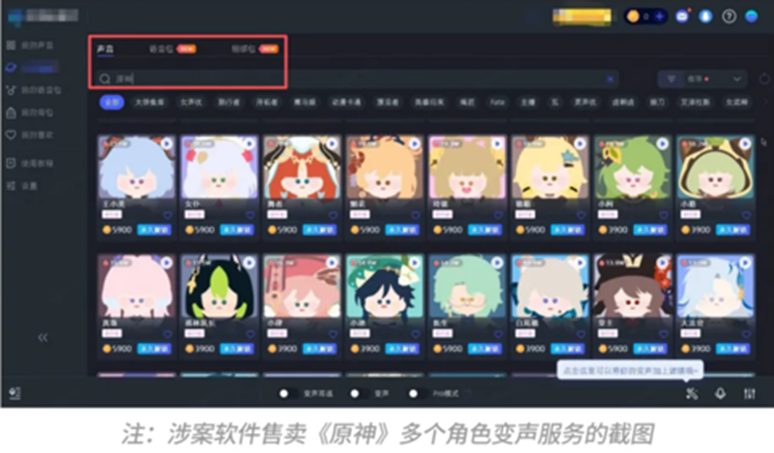
Note: Screenshot of the software at issue selling voice-changing services for multiple “Genshin Impact” characters
During routine inspections, miHoYo discovered that the software developed by the company at issue had, without permission, copied the voices of 63 game characters from “Genshin Impact” and produced them into voice-changing timbre resource packs, which were publicly sold at prices ranging from RMB 19 to RMB 59 per pack. The software also set up a “Traveler” section, providing distinctive nicknames, avatars and other elements related to “Genshin Impact” characters, and posted promotional videos on social media platforms that edited and spliced together the images and voices of “Genshin Impact” characters to attract traffic for software promotion. Some voice packs were used more than 1.92 million times. miHoYo believed that the company at issue had commercially used the relevant voice and visual materials without authorization to improperly obtain traffic and revenue, and therefore filed a lawsuit with Shanghai Pudong Court for copyright infringement and unfair competition.
Upon trial, Shanghai Pudong Court held that the content of the 59 voice resource packs in the software at issue was identical to the lines of the corresponding characters in the “Genshin Impact” game and directly used essential components of the work, thereby constituting copyright infringement. The court also found that the names, classic lines, plot lines, game character images and exclusive voices of 16 characters in “Genshin Impact” had acquired a certain market influence and had the function of identifying the source of goods or services, and thus constituted components of commercial identifiers protected under the Anti-Unfair Competition Law. By editing, cutting and re-splicing the relevant elements for software promotion and traffic attraction, the company at issue easily caused the relevant public to mistakenly believe that the software at issue had a specific connection with “Genshin Impact,” thereby constituting unfair competition.
In the first instance, Shanghai Pudong Court ordered the company at issue to immediately cease copyright infringement and unfair competition, and to compensate miHoYo for economic losses and reasonable expenses totaling RMB 750,000. After the company at issue filed an appeal, the parties reached a settlement through negotiation, and the company at issue voluntarily withdrew the appeal; the first-instance judgment has now become effective.
Source: Legal Department of miHoYo
Beijing Tongzhou People’s Procuratorate handles a foreign-related case of infringement of music copyright
In September 2024, the International Federation of the Phonographic Industry (IFPI) detected that compilation CDs of songs sold at low prices by an online store were infringing products and reported the matter to the Beijing Municipal Comprehensive Law Enforcement Corps for the Cultural Market. Investigation revealed that, since October 2022, Zhai had been mass-burning pirated music CDs in a rented house in Tongzhou District, Beijing, and selling them nationwide through a self-operated online store. To evade liability, Zhai falsely claimed that the online store was operated by his brother-in-law, Pei, and arranged for Pei to “take the blame,” then closed the online store, discarded the burning equipment, and restored his mobile phone and computer to factory settings. After the People’s Procuratorate of Tongzhou District, Beijing lawfully intervened, it found that Pei was unable to explain key operational details such as the receiving account, the source of consumables and the source of audio, and therefore guided the public security organ to adjust the direction of evidence collection and, in combination with the identification by the courier and the landlord, confirmed that Zhai was the actual operator.
The pirated CDs at issue contained more than 600 songs involving multiple foreign record companies. In response to the initial ownership materials lacking core legal basis, the Tongzhou District People’s Procuratorate used the International Standard Recording Code (ISRC) as an important basis for verifying the recordings and their ownership, and, together with IFPI, reviewed and supplemented the ISRCs of the songs at issue one by one; at the same time, it added domestic right holders such as the China Audio-Video Copyright Association and urged foreign right holders to supplement criminal special powers of attorney, and submitted tracks for which ownership could not be confirmed to the Beijing Municipal Press and Publication Bureau for appraisal as illegal publications, thereby improving the evidence of ownership and authorization for domestic and foreign recordings.
After Zhai was brought to justice, he refused to admit the criminal facts and claimed that the high turnover of the online store resulted from fake transactions. The Tongzhou District People’s Procuratorate restored the underlying data on the mobile phone and computer involved in the case, recovered deleted song source files, CD burning records, purchase orders for burners and blank CDs, and records of Zhai taking “custom vinyl” orders via WeChat; it also randomly verified historical orders and cross-checked logistics information, transaction flows and company accounts to rule out the possibility of inflated figures through fake transactions. On this basis, the amount of illegal business involved in the case was increased from the initially recognized more than RMB 700,000 to more than RMB 1.1 million, and the number of pirated CDs was determined to be more than 28,000.
In November 2025, the Tongzhou District People’s Procuratorate instituted a public prosecution against Zhai for the crime of copyright infringement. In February 2026, the People’s Court of Tongzhou District, Beijing found Zhai guilty of the crime of copyright infringement and sentenced him to four years and six months of fixed-term imprisonment and a fine of RMB 600,000; on 15 June 2026, the Third Intermediate People’s Court of Beijing Municipality ruled to dismiss Zhai’s appeal and upheld the original judgment. Pei was separately sentenced to eight months of fixed-term imprisonment for the crime of harboring, and both judgments have become effective.
Source: Procuratorial Daily
News
Source: Broadcasting & Television Circle
Source: National Press and Publication Administration
Source: Xinhua News Agency
Source: Sensor Tower

Image source: Tencent Games
Source: Tencent Games
Cases
Source: Xuhui Procuratorate