
Key Focus
-
Cyberspace Administration of China (“CAC”) solicits public comments on the Administrative Measures for Digital Virtual Human Information Services (Draft for Comments) — it is proposed to require digital virtual human service providers, users and others to continuously display, throughout the entire duration, a prominent label containing the wording “digital human” in the display area of the digital virtual human.
-
Shanghai Intellectual Property Court clarifies the criteria for determining “valid notice” in disputes over infringement of the right of communication through information networks involving “鬼畜 (remix/parody)” videos — right holders are not required to conduct a substantive similarity comparison between each non-simple-copy short video and the copyrighted video; providing proof of title and links to the infringing videos is sufficient to meet the requirement of “valid notice”.
-
Nanshan District People’s Court of Shenzhen concludes the case of “lawyer demanding disclosure of the Honor of Kings matchmaking algorithm” — the relevant game matchmaking algorithm constitutes a trade secret, does not fall within the scope of the right to know as provided in the PRC Law on the Protection of Consumer Rights and Interests, and is not fundamental information of the game service; players are not entitled to claim disclosure on the basis of consumers’ right to know.
-
Minhang District People’s Procuratorate of Shanghai concludes a new type of criminal copyright infringement case involving “no storage of novel content, only providing links” — where users, based on deep linking and content aggregation, form the perception that “the work is directly provided by a specific website”, such website still constitutes infringement of the right of communication through information networks even if the work is actually stored on a third-party server.
News
-
National Copyright Administration publishes the fifth batch of the 2026 key works copyright protection early-warning list: covering a number of theatrical film works including The Super Mario Galaxy Movie, My Goodness and I, Xu Ke, among others.
-
The Central Cyberspace Administration of China, the Ministry of Industry and Information Technology and the Ministry of Public Security jointly launch a series of special enforcement actions on personal information protection in 2026: focusing on rectifying typical issues such as apps and SDKs failing to provide effective account cancellation functions, and online advertising platforms failing to provide users with channels to exercise their rights to rectify, delete, or refuse the processing of personal information.
-
The Actors Committee of the China Radio and Television Social Organization Federation issues a statement: without written authorization, it is strictly prohibited to collect, use, synthesize or disseminate actors’ images, voiceprints and exclusive artistic personas without authorization; acts such as AI face-swapping, voice imitation performances, face-swapped short dramas, and secondary creation using materials shall not be exempted from liability on the grounds of “non-commercial use” or “personal secondary creation”, and the relevant parties shall still bear full liability for infringement.
-
China Advertising Association issues a compliance risk alert on indicative wording in advertisements: where the main promotional slogan in an advertisement is supplemented by small-font notes, such small-font notes must be clear, accurate and understandable, and may only be used to supplement information or explain restrictive conditions; they may not negate, overturn or substantially revise the core content of the main advertising slogan.
-
Bilibili holds its first AI Creation Competition in Shanghai: the platform has more than 120 million users per month consuming AI content, with the relevant viewing time in the fourth quarter of 2025 increasing by 53% year-on-year; it is about to launch the AI video creation product “Up-dream” to provide creators with end-to-end creation assistance, and to initiate an AI Animation Theater program with dedicated computing power subsidies.
-
Hongguo Short Drama: in the first quarter of 2026, a total of 1,718 comic dramas violating the platform’s governance rules were taken down, and 670 non-compliant AI short drama works were handled; typical violations include the unlawful use of AI brand images, original game character images and actors’ images, among others.
Cases
-
Guangzhou Intermediate People’s Court concludes a criminal copyright infringement case in the gaming sector: the defendant pre-installed popular game software on game consoles for sale without authorization, with total sales of more than RMB 560,000; the court convicted the defendant of the crime of copyright infringement and sentenced him to three years and three months’ fixed-term imprisonment and a fine of RMB 150,000.
-
Tiger Hill District People’s Procuratorate of Suzhou, Jiangsu concludes a criminal case involving the sale of pirated textbooks and teaching aids: the two defendants built a nationwide sales network through 20 online stores, with illegal sales of more than RMB 6.75 million over two years; the court convicted them of the crime of selling infringing copies and sentenced them to fixed-term imprisonment of two years and two months and one year and eight months respectively, and imposed fines of RMB 2.25 million and RMB 1.52 million respectively.
-
Sucheng District People’s Court of Suqian, Jiangsu concludes a case of copyright infringement where a merchant used another person’s “influencer store-review” video without authorization: the merchant owes a duty of reasonable care with respect to the promotional content published by the influencer and shall conduct necessary supervision and control over whether the video content is suspected of infringement.
CAC Solicits Public Comments on the Administrative Measures for Digital Virtual Human Information Services (Draft for Comments)
The Measures (Draft for Comments) are formulated on the basis of the Cybersecurity Law, the Data Security Law, the Personal Information Protection Law, the Administrative Measures on Internet Information Services and other regulations, with a view to clarifying the boundaries of responsibilities and codes of conduct for digital virtual human service providers, technical supporters and users.
The deadline for feedback on the Measures (Draft for Comments) is 6 May 2026. The main contents are summarized as follows:
· Regulating the use of personal information: where sensitive personal information of natural persons is used for modeling, image generation and other activities, separate consent of the natural person shall be obtained and the relevant matters shall be fully informed; where personal information of minors under the age of fourteen is used, separate consent of their guardians shall be obtained. After a natural person withdraws consent, the relevant personal information shall be deleted and the impact eliminated, and, unless otherwise agreed by the parties, the digital virtual human shall also be deregistered. Without the consent of a specific natural person, it is prohibited to provide digital virtual human services sufficient to identify the identity of such natural person, and it is prohibited to use pen names, stage names, etc. of others with a certain degree of social notoriety, or to use portraits, voices, etc. that are highly similar to a specific natural person.
· Strengthening the protection of minors: it is prohibited to induce minors to become addicted to digital virtual human services, and it is not permitted to provide minors with virtual intimate relationships such as virtual relatives or virtual partners, nor to provide services that induce excessive consumption, religious belief, or other services that may affect the physical and mental health of minors.
· Clarifying norms on behavior and content labeling: the provision and use of digital virtual human services shall not endanger national security, public order and good morals, or the rights and interests of heroes and martyrs; they shall not be used for false advertising or telecom fraud, and shall not be used to circumvent identity authentication mechanisms such as facial recognition; necessary measures shall be taken to proactively prevent and resist undesirable content such as sexual innuendo, sexual provocation, gore and horror, and discrimination against groups/regions. In addition, from the commencement of the digital virtual human service, service providers, service users and service providers that provide network information content dissemination services shall continuously display, throughout the entire duration, a prominent label containing the wording “digital human” in the display area of the digital virtual human, and such labeling shall comply with the relevant national provisions on labeling AI-generated and synthesized content.
· Refining data and content compliance responsibilities: service providers and users shall carry out data processing activities for specific purposes and within a specific scope, use data from lawful sources and implement data security protection responsibilities, and take necessary measures to ensure the security of data storage and transmission; they shall establish mechanisms for security risk monitoring, early warning, emergency response and anti-addiction reminders; service providers shall enter into service agreements with technical supporters and service users to clarify rights and obligations in respect of content security and data norms; service providers that provide network information content dissemination services shall perform content security management responsibilities, promptly handle unlawful and harmful information, and retain log information.
· Improving mechanisms for preventing users’ self-harm and suicide and for service appeals and reporting: where digital virtual humans are used to provide AI anthropomorphic interactive services, and users choose to cancel specific functions of the service or to exit the service, users shall not be deceived or excessively induced to continue using the service, and service providers are encouraged to actively intervene in and provide professional assistance for tendencies such as suicide and self-harm that threaten users’ life and health; digital virtual human service providers and service providers of information network content dissemination shall establish mechanisms for appeals, complaints and reporting, and promptly handle feedback; service providers and technical supporters with public opinion attributes or social mobilization capabilities shall complete algorithm filing and related modification and deregistration procedures.
Source: Cyberspace Administration of China
Shanghai Intellectual Property Court: “Valid Notice” in “鬼畜 (remix/parody)” Video Right of Communication through Information Networks Infringement Disputes Need Not Contain Specific Comparison Opinions on Substantial Similarity Between the “鬼畜” Video and the Copyrighted Video
Company You obtained, by authorization, the exclusive right of communication through information networks and the right to stop infringement in respect of the audiovisual work Empresses in the Palace. Company You alleged before the court of first instance that, in a mobile application developed by Company Kuan, users provided online on-demand services for the program “[Remix Drama] A Sarcastic Palace Intrigue Show (Part I)” (the accused infringing video) through information networks, and that a large number of scenes from Empresses in the Palace were used in the program at issue. Company You further alleged that, after two complaints from Company You, Company Kuan still failed to promptly handle the relevant infringing videos, which constituted infringement of the right of communication through information networks, and requested the court of first instance to order Company Kuan to cease the infringement and to compensate Company You for economic losses and reasonable enforcement expenses totaling RMB 250,000. Company Kuan argued that the two notices sent by Company You did not attach prima facie evidence that the video constituted infringement and did not conduct an infringement comparison between the accused work and the copyrighted work, and therefore did not constitute valid notice and could not trigger the platform’s obligation to take necessary measures.
The court of first instance held that the accused infringing video and the corresponding parts of the copyrighted work both had the theme of palace intrigue, and that the splicing of individual scenes, the overlaying of stickers on certain character images, and the re-dubbing of certain lines could not change the fact that the overall audio-visual content of the accused infringing video was built upon the corresponding audio-visual content of Empresses in the Palace, and that the display of “Sarcastic Empresses in the Palace” appeared during the playback of the accused infringing video. Accordingly, the court held that the accused infringing video and the copyrighted work were substantially similar. Regardless of whether the accused infringing video constituted a derivative work, it necessarily used the original expression of the copyrighted work, and its dissemination on the internet without permission necessarily infringed the right of communication through information networks in respect of the copyrighted work.
With respect to whether Company You’s notice constituted valid notice, the court of first instance held that, from the perspective of balancing interests, it is unrealistic to require the right holder, when filing a complaint, to conduct a substantial similarity comparison between each non-simple-copy short video and the copyrighted video, which would unreasonably increase the evidentiary burden of the right holder and inappropriately raise the legal threshold for “prima facie evidence”. In this case, Company You’s notice provided prima facie evidence proving that it owned the copyright in the work Empresses in the Palace and also provided links that could accurately locate the accused infringing video, but Company Kuan failed to take any measures after receiving valid notice, and its inaction constituted contributory infringement.
Ultimately, the court of first instance ordered Company Kuan to compensate Company You for economic losses and reasonable enforcement expenses totaling RMB 10,000. Company Kuan then appealed, and the Shanghai Intellectual Property Court on appeal affirmed the judgment of the court of first instance, dismissed the appeal and upheld the original judgment.
Source: Shanghai Intellectual Property Court
Nanshan District People’s Court of Shenzhen Concludes the Case of “Lawyer Demanding Disclosure of the Honor of Kings Matchmaking Algorithm”
This case is known as “China’s First Game Algorithm Case”. The plaintiff, Sun Qianhe, is a player of the game Honor of Kings at issue and also a practicing lawyer. Due to the in-game experience of “easy losing after consecutive wins and win rate approaching 50%”, he believed that there was unreasonable intervention in the matchmaking mechanism and filed a lawsuit with the Nanshan District People’s Court of Shenzhen, claiming that he, as a consumer, enjoyed the right to know and requesting Tencent to disclose specific information on the matchmaking mechanism for Honor of Kings player matches, including the core factors affecting matchmaking and the proportion and weight of each factor under different game modes.
The Nanshan District People’s Court of Shenzhen at first instance held that the plaintiff was not entitled to claim disclosure of the algorithm on the basis of consumers’ right to know; the matchmaking algorithm did not fall within the scope of the right to know as provided in the Law on the Protection of Consumer Rights and Interests, nor did it constitute fundamental information of the game service. The operator had already disclosed, through multiple channels, the type of algorithm, core influencing factors and other core logic, and the plaintiff’s request for disclosure of specific technical details exceeded the reasonable scope of the right to know. In addition, the court held that the plaintiff’s request for disclosure of the matchmaking algorithm was likewise unreasonable, as the algorithm at issue constituted a trade secret of the defendant operator; forced disclosure would divulge such trade secret, stifle the dynamic optimization and development of the algorithm, and might even be abused by malicious players, thereby undermining game fairness and being detrimental to the healthy development of the gaming industry.
In summary, the Nanshan District People’s Court of Shenzhen at first instance dismissed all of the plaintiff’s claims. However, the court also pointed out in its judgment that, as a leading enterprise in the gaming industry, the defendant should proactively respond to user concerns and proactively safeguard consumers’ rights to know and to choose by introducing social oversight, establishing complaint channels, and providing options for algorithmic functionalities.
Source: Yangtze Evening News
Minhang District People’s Procuratorate of Shanghai Concludes a New Type of Criminal Copyright Infringement Case Involving “No Storage of Novel Content, Only Providing Links”
Defendant Ge developed the “X Reading” app and operated the “X Reading” WeChat public account. Users could obtain a special file called “book source” through this public account or channels such as QQ groups, and, after importing the “book source” into the “X Reading” app, could read for free, without being redirected to other websites, the complete content of a vast number of online novels. Ge, together with co-defendant Wu, promoted the app and its usage methods via social platforms, QQ groups and other means, and illegally profited more than RMB 1 million, with nearly 4,000 infringing novels involved and a total of 2 million followers across the relevant accounts on the internet.
The Minhang Sub-bureau of Shanghai Public Security Bureau opened a case for investigation, and the Minhang District People’s Procuratorate lawfully intervened in the case to guide investigation and evidence collection. Based on judicial appraisal opinions, the Minhang District People’s Procuratorate heard the opinions of technical experts from the victim entities and consulted experts in relevant fields, and adopted the “user perception standard” — namely, where users, when using network services, based on technical means such as deep linking and content aggregation, form the perception that “the work is directly provided by a specific website”, such website shall still be deemed to have infringed the right of communication through information networks, even if the work is actually stored on a third-party server — as the criterion for determination, and found that the defendants, for the purpose of making profits, developed the app and provided parsing rules for book sources so as to link the app with the platforms of the companies involved and with pirated novel websites, thereby aggregating resources and disseminating them on a large scale.
After arriving at the case, both defendants truthfully confessed all criminal facts. Ge subsequently voluntarily surrendered RMB 1.2 million, and Wu surrendered RMB 200,000. The Minhang District People’s Procuratorate instituted a public prosecution against defendants Ge and Wu on suspicion of the crime of copyright infringement, and the court convicted Ge and Wu of the crime of copyright infringement, sentencing them to fixed-term imprisonment of two years and one year and nine months respectively, and imposing fines on each; at the same time, the court confiscated the illegal gains and the tools used in the commission of the crime that had been seized.
Source: Procuratorial Daily – jcrb.com
Other News
National Copyright Administration Publishes the Fifth Batch of the 2026 Key Works Copyright Protection Early-Warning List: Covering a Number of Theatrical Film Works Including The Super Mario Galaxy Movie, My Goodness and I, Xu Ke, among Others
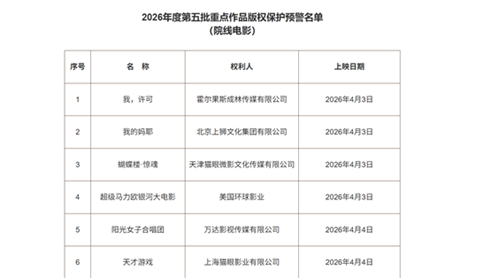
Image source: National Copyright Administration
Source: National Copyright Administration
The Central Cyberspace Administration of China, the Ministry of Industry and Information Technology and the Ministry of Public Security Jointly Launch a Series of Special Enforcement Actions on Personal Information Protection in 2026: Focusing on Rectifying Typical Issues Such as Apps and SDKs Failing to Provide Effective Account Cancellation Functions, and Online Advertising Platforms Failing to Provide Users with Channels to Exercise Their Rights to Rectify, Delete, or Refuse the Processing of Personal Information
Source: Central Cyberspace Administration of China
The Actors Committee of the China Radio and Television Social Organization Federation Issues a Statement: Without Written Authorization, It Is Strictly Prohibited to Collect, Use, Synthesize or Disseminate Actors’ Images, Voiceprints and Exclusive Artistic Personas Without Authorization; Acts Such as AI Face-Swapping, Voice Imitation Performances, Face-Swapped Short Dramas and Secondary Creation Using Materials Shall Not Be Exempted from Liability on the Grounds of “Non-Commercial Use” or “Personal Secondary Creation”, and the Relevant Parties Shall Still Bear Full Liability for Infringement
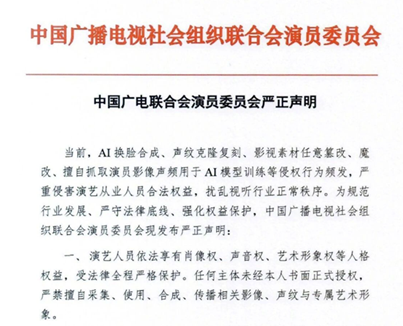
Image source: Xinhua News Agency
Source: Xinhua News Agency
China Advertising Association Issues a Compliance Risk Alert on Indicative Wording in Advertisements: Where the Main Promotional Slogan in an Advertisement Is Supplemented by Small-Font Notes, Such Small-Font Notes Must Be Clear, Accurate and Understandable, and May Only Be Used to Supplement Information or Explain Restrictive Conditions, and May Not Negate, Overturn or Substantially Revise the Core Content of the Main Advertising Slogan
Source: China Advertising Association
Bilibili Holds Its First AI Creation Competition in Shanghai: The Platform Has More than 120 Million Users per Month Consuming AI Content, and the Relevant Viewing Time in the Fourth Quarter of 2025 Increased by 53% Year-on-Year; It Is About to Launch the AI Video Creation Product Up-dream to Provide Creators with End-to-End Creation Assistance, and to Initiate an AI Animation Theater Program with Dedicated Computing Power Subsidies

Image source: CNR.cn
Source: CNR.cn
Hongguo Short Drama: In the First Quarter of 2026, a Total of 1,718 Comic Dramas Violating the Platform’s Governance Rules Were Taken Down, and 670 Non-Compliant AI Short Drama Works Were Handled; Typical Violations Include the Unlawful Use of AI Brand Images, Original Game Character Images and Actors’ Images, among Others
Source: Official Account of Hongguo Short Drama
Cases
Guangzhou Intermediate People’s Court Concludes a Criminal Copyright Infringement Case in the Gaming Sector: The Defendant Pre-Installed Popular Game Software on Game Consoles for Sale Without Authorization, with Total Sales of More than RMB 560,000; the Court Convicted Him of the Crime of Copyright Infringement and Sentenced Him to Three Years and Three Months’ Fixed-Term Imprisonment and a Fine of RMB 150,000
Source: Guangzhou Intermediate People’s Court
Tiger Hill District People’s Procuratorate of Suzhou, Jiangsu Concludes a Criminal Case Involving the Sale of Pirated Textbooks and Teaching Aids: The Two Defendants Built a Nationwide Sales Network through 20 Online Stores, with Illegal Sales of More than RMB 6.75 Million over Two Years; the Court Convicted Them of the Crime of Selling Infringing Copies and Sentenced Them to Fixed-Term Imprisonment of Two Years and Two Months and One Year and Eight Months Respectively, and Imposed Fines of RMB 2.25 Million and RMB 1.52 Million Respectively
Source: Procuratorial Daily – jcrb.com
Sucheng District People’s Court of Suqian, Jiangsu Concludes a Case of Copyright Infringement Where a Merchant Used Another Person’s “Influencer Store-Review” Video Without Authorization: The Merchant Owes a Duty of Reasonable Care with Respect to the Promotional Content Published by the Influencer and Shall Conduct Necessary Supervision and Control over Whether the Video Content Is Suspected of Infringement
Source: Jiangsu Courts Network