
Key Focus
-
The Supreme People’s Court issues the Working Guidelines of the People’s Courts on the Trial of Civil Cases Involving Minors — clarifying the method for determining the validity of contract dispute cases involving minors’ online top-ups and live-streaming rewards, and further refining the factors to be considered in compensation after the relevant contracts are found invalid
-
The Shanghai Intellectual Property Court concludes the nation’s first horizontal monopoly dispute in the gaming industry — the developer and the operating platforms jointly restricted cross-platform interoperability of high-rebate platforms in order to maintain fair competition; as their conduct did not have the effect of eliminating competition, it did not constitute a horizontal monopoly agreement
-
The Beijing Internet Court concludes a case concerning infringement of the right to reputation arising from the publication of content generated by generative AI — users and publishers of AI-generated content may not invoke “the content was generated by AI” as an excuse for exemption from liability so as to evade their duty of prudent review regarding the authenticity, legality, and compliance of the information
News
-
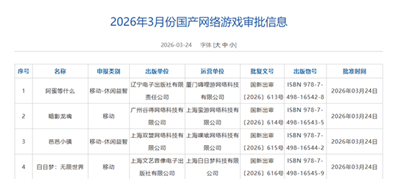
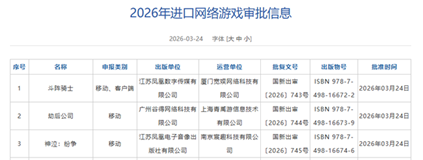
National Press and Publication Administration: In March 2026, a total of 130 domestically developed games and 3 imported games were approved with publication numbers, including Tencent’s “Grainy Little Kingdom”, Kingnet Network’s “Legend of Heroes of the World”, and 37 Interactive Entertainment’s “Little Helmet, Big Adventure”; from January to March 2026, a total of 467 publication numbers were issued for domestic and imported games
-
The National Copyright Administration publishes the fourth batch of the 2026 key works copyright protection early-warning list, covering TV dramas such as “Lantern in Broad Daylight”, “Hello 1983”, and “The Legend of Yunxiang: Toast to the Future”
-
The Shanghai Film and Television Copyright Service Center publishes the February 2026 Shanghai film and television copyright monitoring report: for 10 theatrical-release films, 22,800 suspected infringing links were monitored, mainly concentrated on video websites, social networking sites, and information platforms; for 11 TV dramas, 9,080 suspected infringing links were monitored, mainly concentrated on small websites, video websites, and cloud storage platforms
-
The press conference of the 16th Beijing International Film Festival is held in Beijing: the festival will be held in Beijing from 16 to 25 April, and will, for the first time, set up a copyright promotion fair for Chinese and foreign films and launch a recruitment campaign for the overseas distribution of Chinese-language films; for the first time, the opening and closing ceremonies of the festival will be broadcast live simultaneously on large screens in multiple key commercial districts across Beijing
-
The China Research Institute for Science Popularization releases the 2026 China Science Fiction Industry Report: in 2025, the total revenue of China’s science fiction industry reached RMB 126.1 billion, a year-on-year increase of 15.7%, of which the total revenue of the science fiction film and television industry was RMB 8.16 billion, a year-on-year increase of 21.6%, with AIGC short and medium-length videos performing well; the total revenue of the science fiction game industry was RMB 77.91 billion, a year-on-year increase of 8.5%, with domestically developed science fiction games performing remarkably well in overseas markets
-
Sensor Tower releases the 2026 Global IP Game Market Insights: in 2025, global in-app purchase revenue of licensed IP mobile games reached USD 18.4 billion; Tencent, driven by the strong performance of IPs such as “Honor of Kings” and “League of Legends”, ranked first among global mobile game IP parent companies, and NetEase’s “Marvel Rivals” became the most downloaded PC/console IP game worldwide in 2025
-
The “Seeing Music Project · Industry Conference” co-hosted by Qishui Music and Douyin is held in Beijing: in 2025, the user base of Qishui Music increased by 120% year-on-year, of which 25% were new music streaming users; the platform now has 5.7 million creators and 550,000 musicians, generating 2.2 million pieces of music content per day; in 2026, Qishui Music will continue to host the Qishui Music Festival and strengthen its linkage with film, television, and variety content to broaden the dissemination space of music content
Key Focus
The Supreme People’s Court Issues the Working Guidelines of the People’s Courts on the Trial of Civil Cases Involving Minors
The Guidelines are intended to implement the requirements set out in the Opinions of the CPC Central Committee on Strengthening Adjudication Work in the New Era, including “strengthening judicial protection of the rights and interests of minors”, “implementing the principle of the best interests of the minor”, and “improving the linkage and coordination mechanism of the ‘six protections’ for minors, namely family, school, society, cyberspace, government, and judiciary”. Among these, in the chapter on trial and adjudication, detailed provisions are made in response to hot and difficult issues in judicial practice, with special guidance provided in particular for contract dispute cases in the field of minors’ online consumption.
Specifically, Article 27 of the Guidelines provides that, in the trial of contract dispute cases involving online game top-ups, live-streaming rewards, and the like, where minors are parties, the people’s court shall, based on the nature and content of the specific contract, fully consider the following factors and comprehensively determine whether the act of contracting is commensurate with the minor’s age and intelligence, so as to accurately determine the validity of the contract: first, the degree to which the contract is related to the minor’s daily life; second, whether the minor is able to understand his or her conduct and foresee the corresponding consequences; and third, factors such as the subject matter, quantity, price, or remuneration of the contract.
With respect to the handling of contracts that are determined to be invalid, the Guidelines further provide that, where a party claims restitution of property or compensation at an appraised value in respect of an invalid contract, the people’s court shall grant support; where a party claims damages, the people’s court shall, based on factors such as the minor’s age, intelligence, the contracting process, and the guardian’s performance of guardianship duties, comprehensively determine the degree of fault of each party and the corresponding civil liability.
Source: Supreme People’s Court
The Shanghai Intellectual Property Court Concludes the Nation’s First Horizontal Monopoly Dispute in the Gaming Industry
In this case, the plaintiff, Yun Company (hereinafter, the “plaintiff”), is the operator of the “Kuaiwan” game platform and is responsible for the operation of the game at issue on its platform. The five defendants are all participants in the multi-platform operation of the game at issue. Among them, Defendants 1 and 2 are both the developers of the game at issue and the operators of the game on their own channels; Defendants 3, 4, and 5 are respectively responsible for the operation of the game at issue on the 7K7K, 51 Games, and 4399 game platforms.
In May 2023, citing the “high rebates” on the plaintiff’s platform, Defendant 1 unilaterally suspended the cross-platform interoperability mechanism of the plaintiff’s platform. In June 2024, Defendants 3, 4, and 5 issued announcements on the same day, expressly refusing to resume cross-platform cooperation with the plaintiff’s platform. In addition, Defendant 2 sent the plaintiff a Notice of Early Termination of Agreement, thereby terminating their cooperative relationship. The plaintiff alleged that the above-mentioned conduct of the five defendants constituted horizontal monopoly conduct prohibited by the Anti-Monopoly Law (including market allocation agreements and concerted refusal to deal agreements), which excluded and restricted competition in the game operation market, and therefore brought an action before the Shanghai Intellectual Property Court, requesting that the court order the five defendants to cease their monopolistic conduct and compensate for economic losses in the amount of RMB 2 million.
The Shanghai Intellectual Property Court held that, first, the conduct of the five defendants did not constitute a market allocation agreement. The core online PVP battles, PVE dungeons, and social gameplay of the game at issue require an internet connection and login to the server; therefore, any platform authorized to operate the game can attract all players to play the game, and there is no need to divide regions. Cross-platform gameplay is merely a function based on cross-platform networking technology and networking mechanisms that breaks down platform barriers and does not in itself serve to divide the business territories of the market. Even if the plaintiff’s platform does not have cross-platform gameplay enabled, the platform has not been excluded from the game operation market.
At the same time, although the five defendants, through consultation and consensus, excluded the plaintiff’s game platform from cross-platform gameplay, and such conduct is, in form, a concerted refusal to deal, the purpose of such conduct was to jointly resist the “high rebate” business model adopted by the plaintiff’s platform. Under this model, players on the plaintiff’s platform could obtain the same in-game equipment at extremely low prices that players on other platforms had to pay several times more to obtain, thereby harming the interests of consumers and other game platform operators. Moreover, even if the five defendants refused to resume cross-platform gameplay with the plaintiff, the plaintiff could still operate the game on its own platform. Therefore, the concerted refusal to deal by the five defendants did not result in restricting the plaintiff’s entry into the game operation market. In summary, the Shanghai Intellectual Property Court found that the alleged conduct of the five defendants did not constitute horizontal monopoly conduct, and in the first instance judgment dismissed all of the plaintiff’s claims.
Source: Sohu News
Beijing Internet Court: Where a Publisher of AI-Generated Content Fails to Fulfil the Duty of Fact-Checking, Resulting in the Publication of False Content that Infringes Another’s Right to Reputation, the Publisher Shall Bear Tort Liability
In this case, the plaintiff is an institution engaged in live-streaming business. After a certain streamer under its umbrella unfortunately passed away, the incident attracted public attention. The defendant, through his social media account, posted a video titled “A Certain Streamer Passed Away#Health Preservation#Health#Health Preservation Is Preserving Health#Entrepreneurship#Nutritional Products”, stating that the streamer had “relied on taking medicine and drinking alcohol to hold on, suffering from insomnia and anxiety”, “live-streamed 15 hours a day and recited scripts late at night”, “carried antidepressants and falsely claimed they were throat lozenges”, and that “although doctors required rest and treatment, the team urged him to live-stream”. The plaintiff considered that the above content fabricated facts and disparaged the institution’s reputation, and therefore brought an action before the Beijing Internet Court.
The defendant argued that the video script was not his own original work but was generated by AI, and submitted a screen recording of the content generation process as evidence. The screen recording showed that the defendant instructed the AI to “draft a voice-over script about a certain streamer’s death from illness, advocating attention to health”; after the AI generated a first draft, the defendant requested that online report content be added, and the AI, after retrieving multiple articles from several platforms, revised the script. The defendant then directly used the script to record and publish the video at issue. On this basis, the defendant contended that his content was based on online information and did not constitute infringement of the right to reputation.
Upon trial, the Beijing Internet Court held that the “certain streamer” mentioned in the video at issue was a contracted streamer under the plaintiff, and it could therefore be determined that the “team” referred to in the video pointed to the plaintiff. As to whether the defendant’s relevant statements had a factual basis, the court pointed out that the defendant, as a user of generative artificial intelligence services, bears a statutory duty to conduct necessary verification of relevant information when using AI-generated content to produce and publish videos. In this case, when publishing the video at issue, the defendant neither indicated the sources of the information nor verified the authenticity and reliability of such sources, and failed to submit valid evidence proving that specific statements such as “live-streaming 15 hours a day and reciting scripts late at night” and “doctors asked him to rest and receive treatment, but the team urged him to live-stream” were objectively true. After the video at issue was published, multiple netizens posted negative comments about the plaintiff in the comment section, which objectively resulted in a lowering of the plaintiff’s social evaluation. In summary, the defendant’s act of publishing the video at issue constituted an infringement of the plaintiff’s right to reputation. The Beijing Internet Court ordered the defendant to publish an apology statement through his social media account to apologize to the plaintiff and to compensate for a certain amount of economic loss.
Source: Beijing Internet Court
Other News
National Press and Publication Administration: In March 2026, a total of 130 domestically developed games and 3 imported games were approved with publication numbers, including Tencent’s “Grainy Little Kingdom”, Kingnet Network’s “Legend of Heroes of the World”, and 37 Interactive Entertainment’s “Little Helmet, Big Adventure”; from January to March 2026, a total of 467 publication numbers were issued for domestic and imported games
Source: National Press and Publication Administration
The National Copyright Administration Publishes the Fourth Batch of the 2026 Key Works Copyright Protection Early-Warning List, Covering TV Dramas Such as “Lantern in Broad Daylight”, “Hello 1983”, and “The Legend of Yunxiang: Toast to the Future”
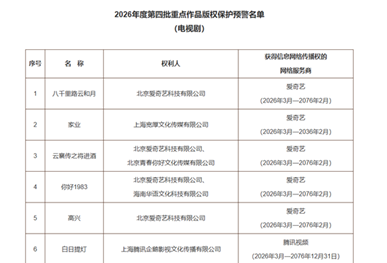
Image source: National Copyright Administration
Source: National Copyright Administration
The Shanghai Film and Television Copyright Service Center Publishes the February 2026 Shanghai Film and Television Copyright Monitoring Report: For 10 Theatrical-Release Films, 22,800 Suspected Infringing Links Were Monitored, Mainly Concentrated on Video Websites, Social Networking Sites, and Information Platforms; For 11 TV Dramas, 9,080 Suspected Infringing Links Were Monitored, Mainly Concentrated on Small Websites, Video Websites, and Cloud Storage Platforms
Source: Shanghai Film and Television Copyright Service Center
The Press Conference of the 16th Beijing International Film Festival Is Held in Beijing: The Festival Will Be Held from 16 to 25 April in Beijing, and Will, for the First Time, Set Up a Copyright Promotion Fair for Chinese and Foreign Films and Launch a Recruitment Campaign for the Overseas Distribution of Chinese-Language Films; for the First Time, the Opening and Closing Ceremonies of the Festival Will Be Broadcast Live Simultaneously on Large Screens in Multiple Key Commercial Districts across Beijing
Source: State Council Information Office
The China Research Institute for Science Popularization Releases the “2026 China Science Fiction Industry Report”: In 2025, the Total Revenue of China’s Science Fiction Industry Reached RMB 126.1 Billion, a Year-on-Year Increase of 15.7%, of Which the Total Revenue of the Science Fiction Film and Television Industry Was RMB 8.16 Billion, a Year-on-Year Increase of 21.6%, with AIGC Short and Medium-Length Videos Performing Well; the Total Revenue of the Science Fiction Game Industry Was RMB 77.91 Billion, a Year-on-Year Increase of 8.5%, with Domestically Developed Science Fiction Games Performing Remarkably Well in Overseas Markets
Source: China Association for Science and Technology
Sensor Tower Releases the “2026 Global IP Game Market Insights”: In 2025, Global In-App Purchase Revenue of Licensed IP Mobile Games Reached USD 18.4 Billion; Tencent, Driven by the Strong Performance of IPs Such as “Honor of Kings” and “League of Legends”, Ranked First among Global Mobile Game IP Parent Companies, and NetEase’s “Marvel Rivals” Became the Most Downloaded PC/Console IP Game Worldwide in 2025
Source: Sensor Tower
Qishui Music x Douyin “Seeing Music Project · Industry Conference” Is Held in Beijing: In 2025, the User Base of Qishui Music Increased by 120% Year-on-Year, of Which 25% Were New Music Streaming Users; the Platform Now Has 5.7 Million Creators and 550,000 Musicians, Generating 2.2 Million Pieces of Music Content per Day; in 2026, Qishui Music Will Continue to Host the Qishui Music Festival and Strengthen Its Linkage with Film, Television, and Variety Content to Broaden the Dissemination Space of Music Content

Image source: Qishui Music
Source: Jiemian News