
Key Focus
-
Guangdong Provincial People’s Government issues the “15th Five-Year Plan for Digital Guangdong Development” — by 2030, the revenue of new cultural formats in the province will increase from 40.3% to 48% of the total revenue of cultural industries above designated size; the Plan will focus on developing the film and television animation, game and e-sports, and online audiovisual industries, cultivating a cluster of Guangdong digital-intelligent cultural IP, building incubation bases for cultural foundation models, and promoting the export of online literature, online dramas and online game culture.
-
Guangzhou Internet Court concludes a dispute over the blocking of an online game account — after the player was muted twice and repeatedly warned, he continued to harass minors in the in-game chat channel; the court held that a ten-year ban did not exceed the scope of penalties stipulated in the service agreement, and dismissed all his claims for unblocking the account or refunding more than RMB 40,000 in top-up payments.
-
Hangzhou Municipal Administration for Market Regulation investigates the first trade secret case nationwide involving a vertical AI foundation model — a senior algorithm expert, during his employment, disclosed to a company under his actual control proprietary prompt templates, review rules and annotation specifications for an AI model; the combination of the relevant materials was found to constitute a new integrated technical trade secret; the law enforcement authority ordered him to cease the acts of disclosure and licensed use, and imposed a fine of RMB 350,000.
-
China Audio-Video and Digital Publishing Association releases the “China Digital Music Industry Report (2025–2026)” — in 2025, the size of China’s digital music market reached RMB 231.85 billion, a year-on-year increase of 9.7%, and the cumulative catalogue of platforms reached 337 million tracks; the Report sets out four AI music governance principles, namely licensing of training materials, identification of generated content, feedback of creative proceeds, and infringement governance, and discloses that the Association is promoting the formulation of a group standard on information labelling for AI-generated and synthesized music.
News
-
The National Copyright Administration issues the thirteenth batch of the 2026 key works copyright protection early-warning list: 25 theatrical films and TV dramas, including “The Cat in the Hat”, “Mount Everest: The Other Side of the Clouds” and “We Live in Nanjing”, are included in the list.
-
The Office of the Inter-ministerial Joint Conference for Building a Strong Intellectual Property Nation issues the fifth batch of 30 typical cases on building a strong intellectual property nation: these cover the “2+2+6” comprehensive IP service system for cultural and creative industries in the Beijing Chaoyang National Cultural and Creative Experimental Zone, the copyright criminal protection system of public security organs in Zhejiang Province, and the “1+3+5” copyright operation service system of the Changsha Malanshan Video Cultural and Creative Park.
-
China Audio-Video Copyright Association announces a new record in karaoke copyright fee collections: as of 18 November 2026, nationwide karaoke copyright fee collections exceeded RMB 500 million for the first time; the Association has 968 members, representing 5,377 right holders.
-
Huangpu District of Shanghai launches a copyright protection alliance for the performing arts industry and sets up a Bund FTC copyright service station: it provides resident enterprises with copyright registration consultation and rights protection guidance, and distributes service packages containing judicial protection guidelines and information on copyright-related financial services to performing arts enterprises and bloggers.
-
WeChat continues to carry out a special campaign to govern false personas in short videos: a total of 31,528 pieces of non-compliant content have been removed and 1,840 non-compliant accounts have been dealt with, with a focus on rectifying acts such as unauthorized use of AI face-swapping and voice synthesis to impersonate celebrities, and using AI digital humans with fabricated identities for marketing and sales.
-
Hongguo Short Drama issues a notice on the governance of non-compliant micro-short dramas for October 2026: during the month, 12,323 AI dramas and 91 live-action dramas were intercepted or taken down; as of the end of October, a cumulative total of 50,032 infringing and non-compliant works had been dealt with, including 3,860 involving plagiarism and 1,708 involving piracy.
-
Guangzhou showcases the achievements of its game and e-sports industry at the 2026 Guangzhou Cultural Industry Fair: in 2025, the city’s game industry revenue reached RMB 153.245 billion, accounting for 42.8% of the national game market, with overseas revenue reaching RMB 26.4 billion; the exhibition area focuses on self-developed game engines, AI foundation models, XR technologies, and cross-sector applications of games in healthcare, agriculture, culture and tourism, and intelligent vehicles.
-
Tencent releases its financial results for the third quarter of 2026: domestic game revenue increased by 11% year-on-year to RMB 47.6 billion, mainly driven by “Delta Force”, “VALORANT: Radianite Offensive” and “Honor of Kings”; international game revenue decreased by 9% year-on-year to RMB 18.9 billion.
-
NetEase releases its financial results for the third quarter of 2026: net revenues from games and related value-added services decreased by 1.7% year-on-year to RMB 22.9 billion; titles such as “Fantasy Westward Journey”, “Identity V”, “Eggy Party”, “Justice Mobile” and “Where Winds Meet” continue to maintain player engagement.
Cases
- Panyu District Administration for Market Regulation of Guangzhou imposes a fine of RMB 68,288 on Guangzhou My Film & Television Culture Media Co., Ltd.: the company fabricated contact lens wearing experiences through the AI virtual character “Fang Taozi”, and published medical device advertisements without prior review.
Key Focus
Guangdong Provincial People’s Government issues the “15th Five-Year Plan for Digital Guangdong Development”: focusing on the development of film and television animation, game and e-sports, online audiovisual and digital-intelligent cultural IP
The Plan provides that by 2030, the proportion of revenue from new cultural formats in the province in the total revenue of cultural industries above designated size will increase from40.3% in 2025 to48%; the operating revenue of enterprises in the internet and related services industries above designated size will increase from RMB 798.32 billion to RMB 1.1 trillion. The Plan further proposes exploring digital copyright management mechanisms, strengthening intellectual property protection for algorithms, models and other subject matter, and promoting the development of Guangdong’s digital-intelligent cultural industry through the digital-intelligent transformation of cultural resources, the building of industrial clusters, IP development and international communication. The Plan makes the following arrangements for the digital-intelligent cultural industry:
-
Strengthen the advantageous industries of film and television animation, game and e-sports, and online audiovisual: reinforce the digital-intelligent cultural industry chain, focus on building new cultural industry clusters such as digital creativity and e-sports live streaming, cultivate new types of cultural enterprises, and create high-quality Lingnan digital creative works and brands.
-
Strengthen digital copyright and intellectual property protection for algorithmic models: explore digital copyright management mechanisms, strengthen intellectual property protection for algorithms, models and other subject matter, deepen the cultivation, deployment and statistical analysis of patents for digital-intelligent technologies, and improve standards and norms for digital-intelligent technologies as well as flexible regulatory mechanisms.
-
Promote the export of online literature, online dramas and online game culture: build a digital-intelligent cultural communication network, support online literature, online dramas and online games in expanding into overseas markets; at the same time, build digital-intelligent service platforms for enterprises going abroad, digital trade demonstration zones and digital service export bases, so as to advance digital trade and related international cooperation.
-
Cultivate a cluster of Guangdong digital-intelligent cultural IP: build digital-intelligent creative industrial parks and benchmark zones for digital-intelligent culture, promote cultural IP development, industrial agglomeration and the cultivation of digital cultural brands, and build incubation bases for cultural foundation models.
-
Promote “artificial intelligence +” cultural applications: implement “artificial intelligence +” cultural initiatives, increase the supply of high-quality online cultural products, support the intelligent development of archives, libraries, cultural centers, museums and local chronicles institutes, and explore the establishment of co-creation platforms for digital-intelligent culture.
Source: Guangdong Provincial People’s Government
Guangzhou Internet Court concludes a dispute over the blocking of an online game account: player who harassed a minor is banned for ten years; requests for unblocking and refund dismissed
On 20 April 2026, an adult player, Liu, despite knowing that the other party was a 17-year-old high school student, continuously posted vulgar remarks in a three-hour conversation in the in-game team chat channel and induced the other party to meet offline. Previously, Liu’s account had been reported19 times by other players for vulgar remarks, insulting others, etc., and muted twice by the platform, and the operator had also sent multiple warning emails. After verification, the operator banned the account for ten years. Liu considered the penalty excessive and filed a lawsuit seeking to have the account unblocked or to have the cumulative top-up amount of more than RMB 40,000 refunded.
Guangzhou Internet Court held that the game service agreement highlighted in red the clauses prohibiting harassment and the corresponding penalty rules, and Liu clicked to agree when registering, so the agreement is binding on him. Liu, knowing that the other party was a minor, nevertheless continued to post vulgar and explicit remarks, which constituted verbal harassment, and he could not exonerate himself on the ground of “just joking”. After being muted twice and repeatedly warned, Liu still continued to post similar remarks; the operator’s ten-year ban on his account did not exceed the scope of penalties stipulated in the agreement and constituted the performance of the platform’s management responsibilities and its statutory obligations under laws on the protection of minors in cyberspace. The exercise and protection of players’ virtual property rights shall be confined within the scope of reasonable operating rules as prescribed by law and the game service agreement; Liu’s request for a refund of the top-up payments lacks factual and legal basis. The court dismissed all of his claims, and the judgment has now taken legal effect.
Source: Guangzhou Internet Court
Hangzhou Municipal Administration for Market Regulation investigates the first trade secret case nationwide involving a vertical AI foundation model
This is the first trade secret case nationwide involving a vertical AI foundation model. In July 2011, Sun joined an AI enterprise in Hangzhou as a senior algorithm expert and led the development of an AI intelligent review model in a specific vertical field. In December 2023, while still employed, Sun used his spouse’s identity to register and actually control Fayuan (Hangzhou) Technology Co., Ltd. In June 2024, Sun sent to Fayuan’s R&D personnel the right holder’s proprietary prompt templates for the AI model, review rules and annotation specifications, for use in developing a similar AI model.
Following a special assessment by industry experts, the integrated scenario-based intelligent review solution formed by the combination of the above materials was found to possess non-publicity, commercial value and elements of enterprise confidentiality management, and to constitute a new integrated technical trade secret in the vertical AI field. Sun had signed a special confidentiality agreement upon joining the company and was under a duty of confidentiality both during and after his employment. His unauthorized disclosure of the relevant materials violated Article 9(1)(3) and Article 9(2) of the Anti-Unfair Competition Law (as amended in 2019). This case breaks through the previous limitation of AI intellectual property protection mainly focusing on source code, and clarifies that integrated solutions in natural language form and non-standardized operational rules may also be protected as trade secrets when they meet the relevant statutory requirements.
On 28 May 2026, the Hangzhou Municipal Administration for Market Regulation, pursuant to Article 21 of the Anti-Unfair Competition Law, ordered Sun to cease the acts of disclosure and licensed use, and imposed a fine ofRMB 350,000. Fayuan’s acts of trade secret infringement are being handled in a separate case.
Source: Baomiguan
China Audio-Video and Digital Publishing Association releases the “China Digital Music Industry Report (2025–2026)”
According to the Report, in 2025, the size of China’s digital music market reachedRMB 231.85 billion, a year-on-year increase of9.7%; the cumulative catalogue of digital music platforms reached337 million tracks. Among these, the music live streaming market reached RMB 134.25 billion, a year-on-year increase of 12.6%; the music short video market reached RMB 58.38 billion, a year-on-year increase of 8.4%; the online music market reached RMB 31.64 billion, a year-on-year increase of 7.8%; and the online karaoke market reached RMB 7.58 billion, a year-on-year decrease of 15.1%.
The Report points out that music consumption is further extending from traditional online listening to live streaming, short videos and other digital entertainment scenarios, and that AI technologies are rapidly entering the stages of music creation, dissemination, copyright management and commercial operation. The main trends in China’s digital music industry are as follows:
-
Market size continues to expand, with music live streaming becoming the main growth driver: from 2022 to 2025, the size of China’s digital music market increased from RMB 155.49 billion to RMB 231.85 billion, a cumulative increase of approximately 49.1%. In 2025, the combined market size of music live streaming and music short videos reached RMB 192.63 billion, accounting for more than 83% of the total digital music market; among these, music live streaming contributed approximately 73% of the net increase in the annual market size.
-
Online music maintains growth, while the online karaoke market continues to contract: in 2025, the online music market reached RMB 31.64 billion, a year-on-year increase of 7.8%; the online karaoke market, however, decreased from RMB 14.92 billion in 2022 to RMB 7.58 billion in 2025, a three-year decline of approximately 49%.
-
Platform catalogues expand rapidly, with industry focus shifting to work discovery and long-term operation: the cumulative catalogues of digital music platforms increased from 132 million tracks in 2022 to 337 million tracks in 2025, a three-year increase of approximately 155%. As content supply continues to expand, the industry is placing greater emphasis on the discovery of high-quality works, content operation, user relationships and cross-scenario commercial development.
-
Music application scenarios continue to expand: music works are disseminated and commercially used across multiple scenarios through online music, short videos, live streaming, variety shows, offline performances, film and television, games and advertising, and collaboration among platforms, record companies and content operation institutions is further deepening.
-
Copyright data and revenue feedback mechanisms are further improved: the Report proposes unified industry data standards, strengthened cross-platform information interconnection, alignment of licensing records for works with their actual use, and enabling settlement results to be fed back to specific works and right holders, thereby providing data support for copyright revenue allocation and cross-scenario operation.
-
AI music promotes the improvement of rules on licensing, identification and rights protection: the Report proposes strengthening licensing of training materials, identification of AI-generated and synthesized music, value feedback to creators, and infringement governance. China Audio-Video and Digital Publishing Association is working with relevant parties to formulate the group standard “Methods for Information Labelling of AI-Generated and Synthesized Music”, in order to promote the improvement of information labelling norms for AI-generated and synthesized music.
Source: Jiemian News
Other News
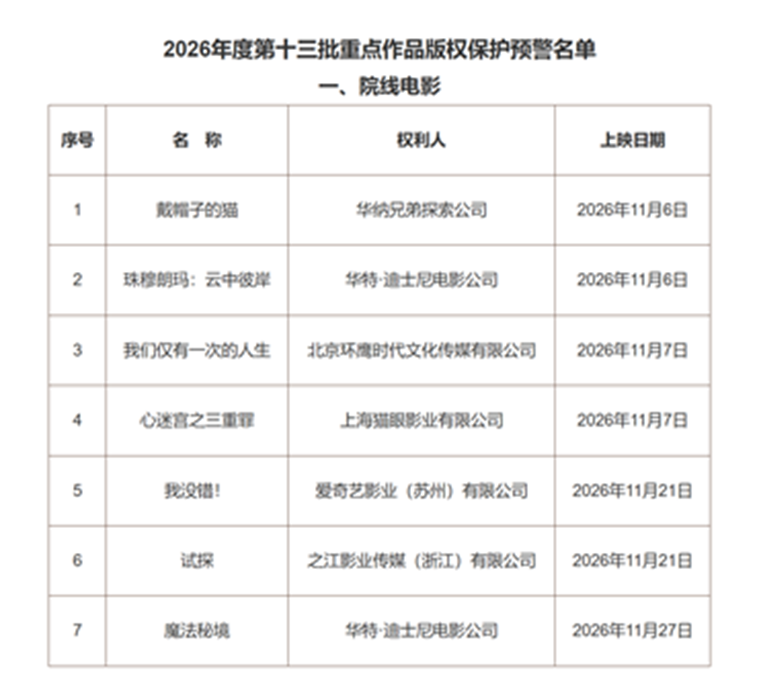
Image source: National Copyright Administration
Source: National Copyright Administration
Source: China National Intellectual Property Administration
Source: China Audio-Video Copyright Association
Source: People’s Government of Huangpu District, Shanghai
Source: WeChat Coral Security
Source: Official account of Hongguo Short Drama
Source: Guangzhou Municipal People’s Government
Source: Tencent Investor Relations
Source: NetEase Investor Relations
Cases
Source: CNR.cn