
Key Focus
- The Cyberspace Administration of China (CAC) has launched a special campaign titled “Clean and Clear · Rectification of Irregularities in AI Applications” — focusing on rectifying typical violations in AI application services such as AI data poisoning and failure to properly implement labeling of generated and synthetic content, as well as addressing AI information content chaos including the use of AI to generate “digital swill,” produce and disseminate false information, spread violent and vulgar content and other harmful information, and impersonate or counterfeit others.
- The Shanghai Intellectual Property Court has concluded on appeal Shanghai’s first copyright infringement case involving a large-scale AI model — where an AI platform only provides technical services with substantial non-infringing uses, has no obvious subjective fault, and has objectively fulfilled its obligations to “take necessary measures” and “forward notices” with respect to infringing content, it does not constitute infringement.
- The Shenzhen Intermediate People’s Court has released the 2025 typical anti-unfair competition cases of Shenzhen courts — where a party imitates another’s doll products with a certain influence in terms of overall shape or color, basic bodily features, iconic decorative features or pose features, and only makes differentiated designs in non-iconic decorative features and pose features, it can generally be found that there is a likelihood of confusion.
- The Ningbo Intermediate People’s Court has released the 2025 typical IP adjudication cases of Ningbo courts — where a short drama extracts and reproduces the sequence of events that drives the core plot of a novel, such as the setting of relationships among multiple characters, the selection of events connecting those relationships, and the arrangement of various plot twists, the two works may be found to be substantially similar.
- The Xiamen Intermediate People’s Court has released the 2025 typical cases on judicial protection of intellectual property rights of Xiamen courts — where the defendant intentionally free-rides on the globally well-known “Thomas & Friends” trademark and continues to infringe by preemptively registering similar signs and other means, with an infringement period as long as 10 years and obvious subjective malice, the court applied treble punitive damages and awarded RMB 5 million in damages.
- The Qingdao Intermediate People’s Court has released the 2025 typical cases on judicial protection of intellectual property rights — including Shandong Province’s first criminal copyright infringement case involving cracking and modifying game source code and privately setting up servers to operate pirated games, thereby bringing the source infringement acts of cracking and modifying source code and privately setting up servers within the scope of criminal enforcement.
News
-
The CAC has released the “Report on the Development of the Rule of Law in Cyberspace in China (2025)”: in 2025, a total of 10 “Clean and Clear” special campaigns were deployed, focusing on rectifying irregularities in live-streaming tipping and illegal short videos involving minors, among other content. More than 469,000 illegal videos involving minors have been removed, and more than 31,000 non-compliant accounts have been handled.
-
The CAC stated that cyberspace authorities strictly regulate “self-media” accounts that fail to indicate sources of information for domestic and foreign current affairs, public policies, and social events, fail to label AI-generated content, or fail to label fictional or dramatized content, and more than 98,000 non-compliant accounts have been handled.
-
The National Radio and Television Administration (NRTA) has deployed a centralized rectification campaign targeting the infringing dissemination of TV dramas: the campaign aims to dovetail with the National Copyright Administration’s “Sword Net 2026” special campaign, focusing on addressing the infringing dissemination of TV dramas via illegal websites, browsers, search engines, and online storage services.
-
The NRTA has announced the results of its governance of “AI” modified videos for April 2026: more than 11,000 non-compliant videos have been removed and more than 10 non-compliant accounts have been handled; governance results will be released on a monthly basis going forward.
-
The National Copyright Administration has released the sixth batch of the 2026 key works copyright protection early-warning list, covering 10 theatrical films including “Burning Bibi,” “A Letter to Grandma,” and “Cold War 1994.”
-
The National Press and Publication Administration (NPPA) announced that in April 2026, a total of 147 domestic games and 7 imported games were approved for publication numbers. Tencent’s “Arc Hunter” obtained an imported client game publication number, and NetEase’s “Sea of Oblivion” obtained publication numbers for mobile, client, and console (PS5) games; the total number of games approved for publication numbers in the first four months of 2026 has reached 621.
-
The China Film Administration announced that the total box office of new films released during the 2026 May Day holiday reached RMB 758 million, with 20.8419 million admissions and 2.376 million screenings, representing year-on-year increases of 1.41%, 10.23%, and 2%, respectively; the film “The Vanished Man” became the box office champion of the May Day holiday.
-
Hongguo Short Drama has announced its governance results for AI dramas: more than ten thousand low-quality AI dramas featuring vulgar sensational content, crude visuals, chaotic plot logic, and extreme emotional rendering have been handled. At the same time, it takes copyright protection seriously and has intensified efforts to crack down on violations such as plagiarism of creative ideas and portrait rights infringement.
-
WeChat and Sina Weibo have released their governance results for “AI” modified videos for April 2026: WeChat has intercepted and removed a total of 2,715 non-compliant videos that used TV drama works based on the Four Great Classical Novels, historical themes, revolutionary themes, and heroic role models for “AI modification,” while Weibo has handled 70 related videos.
Cases
-
The State Administration for Market Regulation (SAMR) has released the sixth batch of typical cases in the field of live-streaming e-commerce, including a false advertising case involving the provision of “ranking boosting” and fake traffic services: the party concerned used software to control multiple mobile phones to log into designated live-streaming rooms and charged service fees, and was ultimately fined RMB 40,000.
Key Focus
The CAC Launches Special Campaign “Clean and Clear · Rectification of AI Application Irregularities”
This special campaign aims to clarify the boundaries of technical compliance and standards for content governance, and to regulate the application scenarios and operational conduct of artificial intelligence services. The four-month campaign is divided into two phases. The first phase targets “Typical Violations in AI Application Services,” focusing on regulating technical aspects such as large model filing, corpus compliance, and content labeling; the second phase targets “AI Information Content Chaos,” focusing on illegal application activities such as using generative AI to produce false information, low-quality content, and infringing materials.
The first phase focuses on rectifying seven types of violations: failure to fulfill the obligation to file and register large models; insufficient platform security review and filtering capabilities; non-compliant sources of training corpus or inclusion of illegal or harmful information; implementation of “data poisoning” through tampering with corpus, fabricating data, or malicious marketing; failure to label generated content in accordance with standards or providing “de-labeling” tools; abuse of AI technology to carry out cyberattacks, unauthorized “face-swapping and voice-cloning”, or misappropriating likenesses to provide professional services; and lack of identity authentication and content review mechanisms in open-source communities.
The second phase focuses on seven types of information content issues, including: using AI to distort classic works and mass-produce logically chaotic or value-distorted “digital swill”; producing false or inaccurate information in areas such as politics, people’s livelihood, and emergencies; using “face-swapping” and “voice-cloning” to impersonate public figures or improperly use information of deceased persons; producing and disseminating harmful content such as violence, gore, and vulgar borderline content; generating content that harms the image of minors or promotes negative values; using AI “hosting” technologies to operate accounts in bulk, inflate metrics, manipulate comments, and fabricate false public opinion; and providing counterfeit shell applications and non-compliant functional services such as “one-click undressing” and AI fortune-telling.
Source: China Netcom (China Internet Information Center)
The Shanghai Intellectual Property Court Concludes on Appeal Shanghai’s First Copyright Infringement Case Involving a Large-Scale AI Model: Appeal Dismissed, First-Instance Judgment Upheld
In this case, the plaintiff, Company Y, is the copyright owner of the character image “Medusa” in the well-known IP “Battle Through the Heavens” series of animations. Defendant Li is a user of an AI image generation platform, and defendant Company H is the operator of that AI image generation platform. Company Y discovered that Li had extracted more than twenty image materials of the Medusa character from “Battle Through the Heavens,” and used the platform’s “train LoRA” function to create and generate two “Medusa” LoRA models, which were then published on Li’s platform account. When other users used the models at issue, they could generate images identical or substantially similar to the Medusa image by inputting different prompts.
Company Y argued that “Medusa” constituted a commodity name with a certain influence, and that Li’s conduct infringed Company Y’s reproduction right, adaptation right, and right of communication through information networks in respect of the “Medusa” work, and that Company H, as the operator of the AI platform, had also failed to fulfill its platform responsibilities. The Shanghai Jinshan District People’s Court at first instance found that Li had infringed the reproduction right and the right of communication through information networks, but had not committed unfair competition. The first-instance judgment ordered Li to cease the infringement and compensate Company Y for economic losses and reasonable expenses totaling RMB 50,000, and held that Company H did not constitute infringement because it had no obvious subjective fault and had objectively fulfilled its obligations to “take necessary measures” and “forward notices.” Company Y and Li both appealed to the Shanghai Intellectual Property Court.
On appeal, the Shanghai Intellectual Property Court held that Li’s conduct of inputting images of the Medusa character from Company Y’s “Battle Through the Heavens” series of animations into the LoRA model for training and outputting related generated content infringed Company Y’s reproduction right and right of communication through information networks, and that the Jinshan Court’s discretionary determination that Li should compensate Company Y RMB 50,000 for economic losses and reasonable expenses for rights protection fell within a reasonable range. At the same time, the Shanghai Intellectual Property Court held that Company H mainly provided Li with technical services, which have substantial non-infringing uses, and that Company H did not have the ability to foresee or prevent Li’s infringing conduct. Moreover, Company H had adopted necessary preventive and remedial measures such as “pre-review” and “post-reporting mechanisms,” and, upon receipt of infringement notices, promptly took necessary measures such as deletion, blocking, and disconnection of links; therefore, it need not bear liability for damages.
In addition, given that Company Y had not actually used “Medusa” as a commodity identifier and that it had not acquired a distinguishing function in the market, the Shanghai Intellectual Property Court held that the word and image “Medusa” did not constitute a “commodity name with a certain influence” under the Anti-Unfair Competition Law. Ultimately, the Shanghai Intellectual Property Court dismissed both parties’ appeals and upheld the first-instance judgment.
Source: Shanghai Intellectual Property Court
The Shenzhen Intermediate People’s Court Releases the 2025 Typical Anti-Unfair Competition Cases of Shenzhen Courts
Among the 10 typical anti-unfair competition cases released by the Shenzhen Intermediate People’s Court, there is one case related to unfair competition involving imitation of an IP doll image. The specific facts are as follows:
Case II: Copyright Infringement and Unfair Competition Dispute between Beijing Paomou Cultural and Creative Co., Ltd. and Shenzhen Qianhai Huanmou Technology Co., Ltd.
The plaintiff, Beijing Paomou Cultural and Creative Co., Ltd. (Paomou), is the operator of the SXX series blind-box doll products and the copyright owner of the doll art works. Evidence in the case shows that the products and their trade dress have high distinctiveness and reputation. The defendant, Shenzhen Qianhai Huanmou Technology Co., Ltd. (Huanmou), subsequently manufactured and sold the Pengmou series blind-box doll products, six of which are highly similar to the products at issue in terms of basic bodily features such as head-to-body ratio, face shape, mouth and nose shape, and limb shape, all using iconic decorative features such as spherical braids or earrings and iconic pose features such as standing with legs apart and both hands placed in front of the body, and all featuring a cyberpunk style, but with significant differences in non-iconic decorative features such as hairstyle, clothing, accessories, and makeup, and non-iconic pose features such as the degree to which the eyes are open.
Paomou claimed that Huanmou’s conduct reproduced its art works and imitated its commodity trade dress with a certain influence, thereby constituting copyright infringement and unfair competition, and requested an order to cease the infringement and to compensate RMB 3 million for economic losses and reasonable expenses for rights protection. The court of first instance held that Huanmou’s conduct did not constitute copyright infringement but did constitute unfair competition, and ordered Huanmou to compensate RMB 255,932.53 for economic losses and reasonable expenses for rights protection. Dissatisfied, Huanmou appealed to the Shenzhen Intermediate People’s Court.
On appeal, the Shenzhen Intermediate People’s Court held that the products at issue are specific characters with names in the minds of consumers, and that their character traits and the general habits of identifying characters determine that the dolls’ basic bodily features are their main identifying parts. Designers achieve the creation and expression of the dolls’ images and personality traits through the selection, combination, and matching of design elements. These elements either have obvious design individuality themselves, or are repeatedly used in the products to reinforce recognition, or are highlighted in publicity to the relevant public, so that the relevant public associates such elements or symbols with the products at issue. Therefore, these iconic features become core identifying parts with strong distinctiveness. The specific design of the products at issue, combined with their unique cyberpunk style, forms a high degree of distinctiveness.
The accused products imitate the basic bodily features, iconic pose and decorative features, and unique style of the products at issue, and only make distinctions in secondary features; their degree of innovation is limited, and although they do not constitute copyright infringement, they are likely to mislead the public into believing that they are the products at issue or that there is a specific connection with Paomou. A market survey organized by the court showed that a high proportion (61.8%) of the relevant public surveyed actually confused the accused products with the products at issue, further confirming that the trade dress of the accused products has a likelihood of confusion. In summary, the Shenzhen Intermediate People’s Court on appeal held that Huanmou’s conduct constituted unfair competition by imitation and dismissed the appeal, upholding the original judgment.
Source: Shenzhen Intermediate People’s Court
The Ningbo Intermediate People’s Court Releases the 2025 Typical IP Adjudication Cases of Ningbo Courts
Among the 10 typical IP cases released by the Ningbo Intermediate People’s Court, there are two copyright infringement cases involving short dramas. The specific facts are as follows:
Case V: Copyright Infringement Dispute over Adapting a Novel into a Short Drama
The full-length novel “Peach Blossoms, Please Take Up Arms Immediately” was first published at the end of 2023 and quickly topped major popularity charts after being launched online in July 2024. The plaintiffs, Dingmou Company and Dianmou Company, which enjoy the economic rights in the novel, agreed to cooperate in developing a short drama based on the work. On 24 July 2024, the defendant, Kaimou Company, and its affiliates launched the accused short drama “General! My Lady Has Petitioned for Divorce” on the Douyin platform and provided pay-per-view services to the public. The accused short drama exceeded ten million views within just three days of its release. On this basis, the two plaintiffs requested an order that the defendant and its affiliates cease the reproduction and dissemination of the accused short drama, compensate for economic losses, and make a public apology.
Upon trial, the Ningbo Intermediate People’s Court held that the accused infringing short drama is substantially similar to the rights work in terms of story background, character setting, character relationships, the arrangement and progression of the various plot segments throughout the entire storyline, and the expression of specific plot segments (including iconic dialogues and actions), thereby infringing the adaptation right, cinematographic work production right, and right of communication through information networks in the novel at issue. In light of the specific circumstances of the infringement and considering factors such as the contribution of the script, the court ordered the defendants to pay RMB 250,000 in damages, with three affiliated companies bearing joint and several liability within their respective scopes. No appeal was filed after the first-instance judgment, which has become effective.
Case IX: Criminal Case of Infringing Copyright by Disseminating Micro Short Dramas
From March to July 2023, the defendant, Tan, without authorization from the copyright owners, Juemou Company, Jiumou Company, and others, edited their micro short dramas and other audiovisual works and uploaded them to Bilibili, disseminating them online through platform accounts under his personal control, and took the opportunity to sell infringing micro short dramas for profit via cloud storage links and other means. During this period, the total number of clicks on the infringing micro short drama works disseminated by Tan exceeded 2.96 million, and he obtained more than RMB 80,000 in illegal gains.
Upon trial, the Yinzhou District People’s Court of Ningbo held that Tan, for the purpose of making profits and without the permission of the copyright owners, reproduced and distributed their audiovisual works, and that the circumstances were particularly serious, thereby constituting the crime of copyright infringement. Taking into account mitigating circumstances such as Tan’s confession, acceptance of punishment, and obtaining forgiveness, the court convicted Tan of the crime of copyright infringement and sentenced him to three years’ imprisonment, suspended for four years, and a fine of RMB 80,000, and confiscated his illegal gains. No appeal or protest was filed after the first-instance judgment, which has become effective.
Source: Ningbo Intermediate People’s Court
The Xiamen Intermediate People’s Court Releases the 2025 Typical Cases on Judicial Protection of Intellectual Property Rights of Xiamen Courts
Among the 10 typical IP cases released by the Xiamen Intermediate People’s Court, there is one typical case involving punitive damages for trademark infringement of “Thomas & Friends.” The specific facts are as follows:
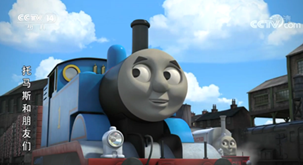
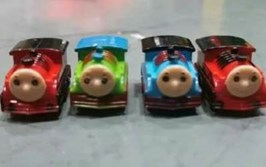
Original “Thomas & Friends” image (left) and actual infringing product image (right)
Image source: Xiamen Intermediate People’s Court
Case IX: Trademark Infringement Dispute between Gumou Company and Yu’s Toy Factory et al.
Since 2015, the defendants in this case have continuously produced and sold track toy products bearing signs similar to the “Thomas & Friends” image trademark owned by the British company Gumou, and have widely distributed them through major domestic e-commerce platforms and overseas shopping websites, with a huge cumulative transaction amount. At the same time, prior to the filing of this case, the defendants had been repeatedly subjected to administrative penalties and customs seizures for the same conduct, but still continued their infringement by preemptively registering similar signs and splitting transaction collection accounts, with cumulative transaction amounts exceeding RMB 15 million.
Upon trial, the Xiamen Intermediate People’s Court held that, knowing that the plaintiff’s trademark enjoys global fame, the defendants not only failed to reasonably avoid it, but instead intentionally free-rode on the trademark at issue, maliciously preemptively registered trademarks similar to the trademark at issue, and counterfeited the trademark at issue, actively and deliberately pursuing the effect of imitation and confusion. In addition, the defendants divided their work and cooperated, and their infringing conduct was highly purposeful, organized, and concealed, with obvious subjective intent.
At the same time, the defendants had been infringing for a long period and failed to correct their conduct after being subjected to administrative penalties, causing a particularly adverse impact. When the court ordered the defendants to submit sales data, financial books, and original vouchers, the defendants still refused to submit them, and their conduct constituted obstruction of evidence. Ultimately, the Xiamen Intermediate People’s Court calculated the infringing profits by multiplying the proven sales amount by the average profit margin of the industry, and used this as the base for punitive damages, applying treble punitive damages, and ordered the defendants to immediately cease the infringement, destroy inventory products and production molds, and fully upheld the plaintiff’s claim for RMB 5 million in damages. Dissatisfied with the first-instance judgment, the defendants appealed, but the Fujian High People’s Court dismissed the appeal and upheld the original judgment.
Source: Xiamen Intermediate People’s Court, Fujian High People’s Court
The Qingdao Intermediate People’s Court Releases the 2025 Typical Cases on Judicial Protection of Intellectual Property Rights
Among the 10 typical cases on judicial protection of intellectual property rights released by the Qingdao Intermediate People’s Court, there is one copyright infringement case involving the operation of private game servers. The specific facts are as follows:
Case IX: Criminal Case of Copyright Infringement Involving the Game Software “Prison of Heaven”
Without the permission of the copyright owner, the defendants Wang and Wei purchased the source code of a legitimate online game, and Wang cracked and modified the source code for operation, after which the two defendants jointly operated the modified online game. Wang sold different modified versions of the online game to the defendant Chen and others. The defendant Wu provided top-up services for the game’s redemption platform and earned handling fees. The defendants also separately invested funds to privately set up game servers and promoted the game through QQ groups. Appraisal showed that the game at issue was substantially similar to the legitimate game.
Upon trial, the Jiaozhou People’s Court held that the seven defendants, without the permission of the copyright owner and for the purpose of making profits, reproduced and distributed computer software, and that the amounts of their illegal gains were respectively large, huge, or involved other particularly serious circumstances, and that their conduct constituted the crime of copyright infringement. In light of mitigating and extenuating circumstances, the court sentenced the defendants to fixed-term imprisonment ranging from six months to three years and fines. The Qingdao Intermediate People’s Court upheld the original judgment on appeal.
Source: Qingdao Intermediate People’s Court
https://mp.weixin.qq.com/s/TGigk43RpS2Mr7pTUgbKQQ
Other News
The CAC Releases the “Report on the Development of the Rule of Law in Cyberspace in China (2025)”: In 2025, a total of 10 “Clean and Clear” special campaigns were deployed, focusing on rectifying irregularities in live-streaming tipping and illegal short videos involving minors, among other content, with more than 469,000 illegal videos involving minors removed and more than 31,000 non-compliant accounts handled
Source: CAC
CAC: Cyberspace Authorities Strictly Regulate “Self-Media” Accounts that Fail to Indicate Sources of Information for Domestic and Foreign Current Affairs, Public Policies, and Social Events, Fail to Label AI-Generated Content, or Fail to Label Fictional or Dramatized Content, and Have Handled More Than 98,000 Non-Compliant Accounts
Source: China Netcom (China Internet Information Center)
NRTA Deploys Centralized Rectification Campaign Targeting Infringing Dissemination of TV Dramas: Aims to Dovetail with the National Copyright Administration’s “Sword Net 2026” Special Campaign, Focusing on Addressing Infringing Dissemination of TV Dramas via Illegal Websites, Browsers, Search Engines, and Online Storage Services
Source: National Radio and Television Administration
Source: CCTV News
The National Copyright Administration Releases the Sixth Batch of the 2026 Key Works Copyright Protection Early-Warning List, Covering 10 Theatrical Films Including “Burning Bibi,” “A Letter to Grandma,” and “Cold War 1994”
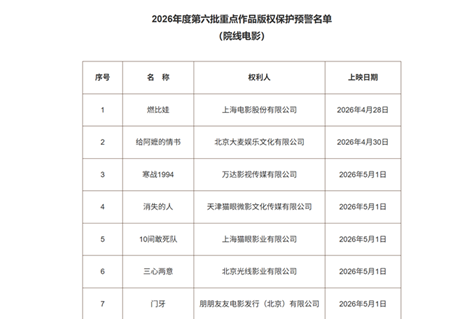
Image source: National Copyright Administration
Source: National Copyright Administration
NPPA: In April 2026, a Total of 147 Domestic Games and 7 Imported Games Were Approved for Publication Numbers; Tencent’s “Arc Hunter” Obtained an Imported Client Game Publication Number, and NetEase’s “Sea of Oblivion” Obtained Publication Numbers for Mobile, Client, and Console (PS5) Games; the Total Number of Games Approved for Publication Numbers in the First Four Months of 2026 Has Reached 621
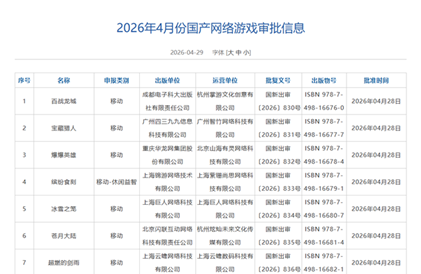
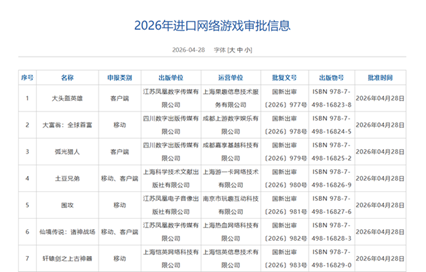
Image source: NPPA
Source: NPPA
Source: CCTV News
Hongguo Short Drama Announces Governance Results for AI Dramas: More Than Ten Thousand Low-Quality AI Dramas Featuring Vulgar Sensational Content, Crude Visuals, Chaotic Plot Logic, and Extreme Emotional Rendering Have Been Handled; at the Same Time, It Takes Copyright Protection Seriously and Has Intensified Efforts to Crack Down on Violations Such as Plagiarism of Creative Ideas and Portrait Rights Infringement
Source: Beijing Daily
WeChat and Sina Weibo Announce Governance Results for “AI” Modified Videos in April 2026: WeChat Has Intercepted and Removed a Total of 2,715 Non-Compliant Videos that Used TV Drama Works Based on the Four Great Classical Novels, Historical Themes, Revolutionary Themes, and Heroic Role Models for “AI Modification,” While Weibo Has Handled 70 Related Videos
Source: WeChat Coral Security, Sina Weibo
Cases
SAMR Releases the Sixth Batch of Typical Cases in the Field of Live-Streaming E-Commerce, Including a False Advertising Case Involving the Provision of “Ranking Boosting” and Fake Traffic Services: the Party Concerned Used Software to Control Multiple Mobile Phones to Log into Designated Live-Streaming Rooms and Charged Service Fees, and Was Ultimately Fined RMB 40,000
Source: State Administration for Market Regulation