

Key Focus
-
The National Copyright Administration released the Top Ten Nationwide Anti-Piracy and Anti-Infringement Cases for 2025 — the infringed objects in the selected cases cover key film and television works such as “Nezha: The Devil Child Stirs the Sea,” as well as comics, music, cultural and creative products, fine art works, books and teaching materials, computer software and other diversified cultural formats. In six of the cases, the amount involved exceeded RMB 10 million, and the longest sentence imposed on the defendants was seven years’ imprisonment.
-
The National Copyright Administration released Ten Typical Anti-Piracy and Anti-Infringement Cases in the Film and Television Sector for 2025 — the dissemination carriers cover a variety of terminals including pirate film and television websites, mobile apps, short-video platforms and network set-top boxes with pre-installed pirate software. The infringement models include direct uploading, aggregation of resource links, secondary publication through editing and clipping, and bundled sales in the form of “set-top box hardware + software.” The highest amount involved in a single case exceeded RMB 20 million.
-
The National Press and Publication Administration released the online game approval information for May 2026 — a total of 158 domestic and imported games were granted publication numbers in the month. In the first five months of 2026, a total of 779 domestic and imported games were approved, representing a year-on-year increase of 19.1% compared with the same period of the previous year.
News
-
The National Copyright Administration revised the “Standard Form Book Publishing Contract” and renamed it the “Model Copyright License Contract (Book Publishing)”; the new model text further standardizes copyright licensing procedures in the field of book publishing and facilitates the “going global” of Chinese cultural products.
-
Box office revenue for films released during the May 20, 2026 slot reached RMB 179 million, a year-on-year increase of 277.2%, ranking fourth in the historical box office for this slot. Among them, “A Letter to Grandma” achieved box office revenue of RMB 96.01 million during the slot, contributing 53.6% of the slot’s box office. As of 26 May, the cumulative box office of “A Letter to Grandma” had exceeded RMB 1.1 billion, with forecast box office of RMB 1.8 billion, and the producer’s investment return ratio may reach 50 times.
-
China Cultural Media Group released the “Report on Development Trends of China’s Cultural and Creative Industries”: in 2025, operating revenue of cultural enterprises above the designated size nationwide reached RMB 15.2 trillion, of which content creation and production amounted to RMB 3.5 trillion, a year-on-year increase of 13.5%; creative design services amounted to RMB 2.7 trillion, a year-on-year increase of 12.3%. The momentum of cultural and creative development is strong, and “Guochao” (China-chic) brands are accelerating their expansion overseas.
-
The 10th China Internet Copyright Protection and Development Conference was held in Shenzhen, Guangdong: it called for the scientific formulation of the “15th Five-Year Plan for Copyright Work,” acceleration of the revision of administrative regulations supporting the Copyright Law, and strengthening of systematic protection of online copyright and copyright supervision in key areas.
-
The China Copyright Association hosted the sub-forum “Upholding Originality and Escorting Development — Building a New Ecosystem for the Micro-Short-Drama Industry” in Shenzhen, Guangdong: it proposed that platforms should ensure that complaint channels are unimpeded and efficient, remove restrictions on complaint frequency, number of complaints, file size, etc., and eliminate obstacles to rights protection; accounts that repeatedly or maliciously infringe should be dealt with strictly.
-
Tencent Music released the “Announcement on Termination of Exclusive License Contracts for Online Audio Content”: it undertook “not to enter into or in disguised form enter into exclusive copyright license contracts with relevant copyright owners” and, at the same time, to “waive the rights relating to exclusive licensing under exclusive copyright contracts for online audio content with relevant copyright owners.”
-
Douyin E-commerce launched a special rectification campaign targeting blind-box trendy toys: it will crack down severely on violations such as non-transparent probabilities for blind-box draws, merchants promoting goods in an uncertain manner, inducing users to consume by exploiting game-theory psychology, or inducing consumers to jump to third-party websites for points redemption.
-
Volcano Engine’s one-stop AIGC short-drama creation platform “Volcano Drama Creation 1.0” was officially launched: it is deeply adapted to models such as Seedance and Seedream, can realize efficient and controllable “director-level content control” capabilities, and can shorten the production cycle of short dramas by more than 80%.
Cases
-
The National Copyright Administration released Ten Typical Anti-Piracy and Anti-Infringement Cases in the Book Sector for 2025: e-commerce platforms remain high-incidence areas for book piracy and copyright infringement; in multiple cases, the amount involved exceeded RMB 10 million, with the highest exceeding RMB 85 million, and the longest sentence imposed on the defendants was five years and nine months’ imprisonment.
Key Focus
The National Copyright Administration Released the Top Ten Nationwide Anti-Piracy and Anti-Infringement Cases for 2025
The titles and brief facts of the ten cases released are as follows:
-
Case of a Beijing Trading Company Infringing the Copyright in Cultural and Creative Works — without the permission of the copyright owners, the infringer sold cultural and creative products of institutions such as the National Museum through its e-commerce platform store, obtaining illegal gains of RMB 11,031. In accordance with Article 53 of the Copyright Law, the Beijing Comprehensive Law Enforcement Corps for the Cultural Market imposed an administrative penalty of a fine of RMB 194,000 on the company.
-
Case of a Shanghai Technology Company Infringing the Copyright in Audiovisual Works — on the infringer’s website, multiple users, without permission, made available to the public cloud-disk resources of audiovisual works such as “Detective Chinatown 1900,” involving 319 theatrical films and audiovisual works included in the National Copyright Administration’s Copyright Protection Early-Warning List. The website ought to have known that its users were extensively disseminating cloud-disk resources of infringing film and television works, yet still provided convenience for such dissemination. The Law Enforcement Corps of the Shanghai Municipal Administration of Culture and Tourism imposed an administrative penalty of a fine of RMB 200,000 on the company.
-
Case of Hua XX and Others in Jing’an District, Shanghai Infringing the Copyright in Fine Art Works — without permission, Hua XX and others operated a pirate comic app to disseminate fine art works of overseas copyright owners and made profits by collecting membership fees, advertising fees, etc., with the amount involved exceeding RMB 24 million. The People’s Court of Jing’an District sentenced Hua XX and others to fixed-term imprisonment ranging from four years and nine months to one year for the crime of copyright infringement, and imposed fines ranging from RMB 3 million to RMB 30,000, and imposed a total fine of RMB 7 million on the companies involved.
-
“12·05” Case in Zhenjiang, Jiangsu of Infringement of Copyright in Teaching Materials — Wang XX and others printed and purchased pirate primary and secondary school textbooks such as “Chinese” and “Mathematics” and sold them through e-commerce platform stores, with the amount involved exceeding RMB 35 million. The People’s Court of the Economic Development Zone of Zhenjiang City sentenced Wang XX and others to fixed-term imprisonment ranging from four years and ten months to three years for the crimes of copyright infringement and sale of infringing reproductions, and imposed fines ranging from RMB 17.3 million to RMB 650,000.
-
Case of Xiao XX and Others in Yangzhou, Jiangsu Infringing Software Copyright — without permission, Xiao XX and others sold software products and keys of an overseas copyright owner through e-commerce platform stores and social media accounts, with the amount involved exceeding RMB 60 million. The People’s Court of Gaoyou City sentenced Xiao XX and others to fixed-term imprisonment ranging from five years and six months to four years and nine months for the crime of copyright infringement, and imposed a fine of RMB 5 million on each of them.
-
Case of Ren XX and Others in Jinhua, Zhejiang Infringing the Copyright in Theatrical Films — without permission, Ren XX and others set up multiple pirate film and television websites to disseminate more than 160,000 film works, including film works such as “Nezha: The Devil Child Stirs the Sea” that are included in the National Copyright Administration’s Copyright Protection Early-Warning List, as well as other film and television works, and made profits by placing advertisements, with the amount involved exceeding RMB 17 million. The People’s Court of Dongyang City sentenced Ren XX and others to fixed-term imprisonment ranging from seven years to six months for the crime of copyright infringement, and imposed fines of up to RMB 17.3 million.
-
“6·09” Case in Nanchang, Jiangxi of Infringement of Software Copyright — without the permission of the copyright owners, Zhang XX and others purchased online and obtained cracking key programs for multiple engineering software products for direct sale, or produced key products according to customized requirements for sale, with the amount involved exceeding RMB 34 million. The People’s Court of the High-tech Industrial Development Zone of Nanchang sentenced Zhang XX and others to fixed-term imprisonment ranging from seven years to six months for the crime of copyright infringement, and imposed fines ranging from RMB 4 million to RMB 50,000.
-
Case of a Trading Company in Shangqiu, Henan Infringing the Copyright in Teaching Materials — without permission, a trading company in Shangqiu, Henan sold pirate textbooks such as “Chinese” through e-commerce and live-streaming platform stores. Law enforcement officers seized 610 copies of pirate textbooks on site. The Bureau of Culture, Radio, Television and Tourism of Xiayi County imposed an administrative penalty on the company in the form of a warning, confiscation of illegal gains, and a fine of RMB 230,000.
-
“12·06” Case in Changsha, Hunan of Infringement of Copyright in Books — without permission, Xiao XX and others massively printed pirate primary and secondary school supplementary teaching books and developed agents to sell them through e-commerce platform stores. Public security authorities seized more than 50 types and more than 400,000 copies of pirate books. The People’s Court of Tianxin District of Changsha City and the People’s Court of Changsha County sentenced Xiao XX and others to fixed-term imprisonment ranging from five years and three months to six months for the crimes of copyright infringement and sale of infringing reproductions, and imposed fines of up to RMB 2.82 million.
-
“6·21” Case in Dongguan, Guangdong of Infringement of Copyright in Musical Works — without permission, Mo XX and others produced music USB flash drives and sold them online. Public security authorities seized more than 20,000 pirate music USB flash drives on site, with the amount involved exceeding RMB 11 million. The Third People’s Court of Dongguan City sentenced Mo XX and others to fixed-term imprisonment ranging from three years and three months to two years and three months for the crime of copyright infringement, and imposed fines ranging from RMB 600,000 to RMB 30,000.
Source:National Copyright Administration
The National Copyright Administration Released Ten Typical Anti-Piracy and Anti-Infringement Cases in the Film and Television Sector for 2025
The titles and brief facts of the typical anti-piracy and anti-infringement cases in the film and television sector released this time are as follows:
-
Case of a Company in Dalian, Liaoning Infringing the Copyright in Audiovisual Works — without permission, the infringer sold network set-top boxes with pre-installed pirate film and television apps through its e-commerce platform store, involving hundreds of film and television works, with illegal business turnover exceeding RMB 20,000. The Dalian Municipal Administration of Culture and Tourism imposed an administrative penalty on the company in the form of a warning and a fine of RMB 107,000.
-
Case of Xue XX in Baoshan, Shanghai Infringing the Copyright in Audiovisual Works — without permission, the infringer operated a subtitle website to disseminate 14 film and television works to the public and obtained income through advertisements and rewards. The Baoshan District Administration of Culture and Tourism imposed an administrative penalty on Xue XX in the form of a warning and a fine of RMB 40,000.
-
Case of Zhang XX and Others in Wenzhou, Zhejiang Infringing the Copyright in Audiovisual Works — without permission, Zhang XX and others reproduced music and film and television works to produce 300,000 pirate discs and sold them for profit through self-built websites, online stores, etc., with the amount involved exceeding RMB 6 million. The People’s Court of Yueqing City sentenced Zhang XX and others to fixed-term imprisonment ranging from three years and six months to eleven months for the crime of copyright infringement, and imposed fines of up to RMB 550,000.
-
Case of Chen XX in Jinhua, Zhejiang Infringing the Copyright in Audiovisual Works — without permission, Chen XX set up 18 pirate film and television websites by purchasing domain names and leasing servers, disseminating more than 150,000 film and television works and making profits through advertisements, with the amount involved exceeding RMB 2.4 million. The People’s Court of Dongyang City sentenced Chen XX to fixed-term imprisonment of four years and two months for the crime of copyright infringement, and imposed a fine of RMB 2.5 million.
-
“11·13” Case in Taizhou, Zhejiang of Infringement of the Copyright in Audiovisual Works — without permission, Kang XX disseminated a large number of pirate film and television works through a website and made profits through advertisements, with the amount involved exceeding RMB 3 million. The People’s Court of Wenling City sentenced Kang XX to fixed-term imprisonment of three years and three months for the crime of copyright infringement, and imposed a fine of RMB 1.8 million.
-
Case of Dong XX in Tongling, Anhui Infringing the Copyright in Audiovisual Works — without permission, Dong XX set up a pirate film and television website to disseminate more than 90,000 film and television dramas and made illegal gains of more than RMB 3.1 million through advertisements. The People’s Court of Yian District of Tongling City sentenced Dong XX to fixed-term imprisonment of three years for the crime of copyright infringement, and imposed a fine of RMB 3.2 million.
-
Case of Cheng XX in Jiujiang, Jiangxi Infringing the Copyright in Audiovisual Works — without permission, Cheng XX edited film and television works and published them on a short-video platform, making profits through advertisements and traffic. The Bureau of Culture, Radio, Television and Tourism of Pengze County imposed an administrative penalty on Cheng XX in the form of a warning and a fine of RMB 30,000.
-
Case of Zhou XX and Others in Ji’an, Jiangxi Infringing the Copyright in Audiovisual Works — without permission, Zhou XX and others set up a pirate film and television app to disseminate a large number of film and television dramas and made profits through membership recharges and advertisements, with the amount involved exceeding RMB 20 million. The People’s Court of Jizhou District of Ji’an City sentenced Zhou XX and others to fixed-term imprisonment ranging from three years and six months to one year for the crime of copyright infringement, and imposed fines ranging from RMB 760,000 to RMB 100,000.
-
Case of Guan XX and Others in Luoyang, Henan Infringing the Copyright in Audiovisual Works — without permission, Guan XX and others illegally obtained a large number of film and television resources and linked them to a pirate film and television app they developed, and installed the app on television set-top boxes for sale and profit. The People’s Court of the Old Town District of Luoyang City sentenced Guan XX to fixed-term imprisonment of three years and five months for the crime of copyright infringement, and imposed a fine of RMB 370,000.
-
Case of Zhou XX in Shangqiu, Henan Infringing the Copyright in Audiovisual Works — without permission, Zhou XX set up a pirate website to disseminate more than 90,000 films, TV dramas and other audiovisual works (episodes), and made profits through advertisements, with the amount involved reaching RMB 1.2 million. The People’s Court of Suiyang District of Shangqiu City sentenced Zhou XX to fixed-term imprisonment of three years for the crime of copyright infringement, and imposed a fine of RMB 30,000.
Source:National Copyright Administration
The National Press and Publication Administration Released the Online Game Approval Information for May 2026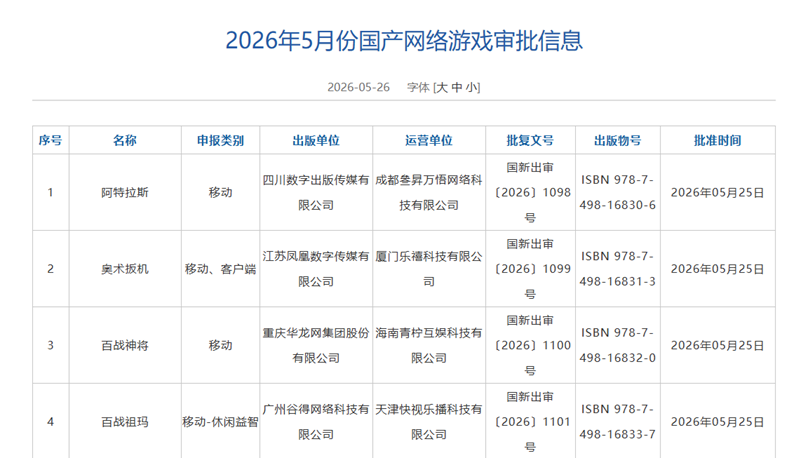
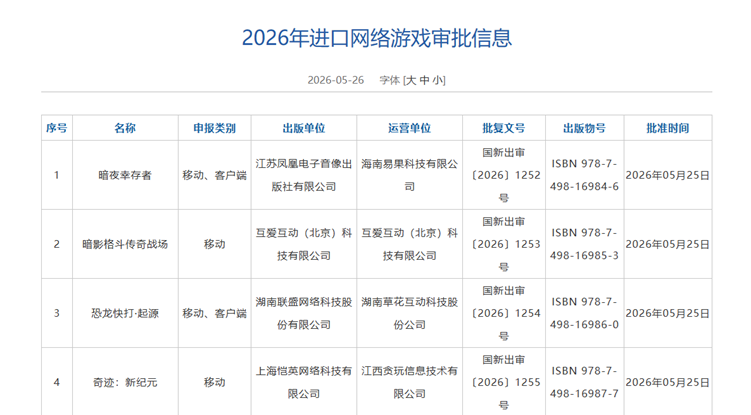
Image source: National Press and Publication Administration
According to the latest data released by the National Press and Publication Administration, a total of 158 games obtained publication numbers in May 2026, including 154 domestic games and 4 imported games. As a result, the total number of game publication numbers issued in the first five months of 2026 has reached 779, representing a year-on-year increase of approximately 19.1% compared with 654 in the same period in 2025, and setting a new high for the number of approvals in the same period since 2021.
While the number of publication numbers issued remains at a high growth level, the terminal distribution and categories of approved games also show a trend of diversification. From the perspective of application platforms, games approved this month still mainly target mobile terminals, including 79 “mobile” games and 56 “mobile – casual puzzle” games. In addition, the trend of multi-terminal interconnection is evident, with a total of 15 games approved for both “mobile and client” terminals, and another 2 games supporting web-based gameplay.
With respect to domestic games, Tencent’s anime-style strategy card RPG game “Chasing Kaleido” was successfully approved. The game had previously conducted overseas tests in countries such as the United States and Japan, accumulating a high level of market attention. With respect to imported games, the classic fighting IP sequel “Shadow Fight: Legendary Battlegrounds” successfully passed approval. The series has accumulated more than 500 million downloads worldwide and has a large player base.
Source:National Press and Publication Administration
Other News
The National Copyright Administration Revised the “Standard Form Book Publishing Contract” and Renamed It the “Model Copyright License Contract (Book Publishing)”; the New Model Text Further Standardizes Copyright Licensing Procedures in the Field of Book Publishing and Facilitates the “Going Global” of Chinese Cultural Products
Source:National Copyright Administration
Box Office Revenue for Films Released During the May 20, 2026 Slot Reached RMB 179 Million, a Year-on-Year Increase of 277.2%, Ranking Fourth in the Historical Box Office for This Slot; Among Them, “A Letter to Grandma” Achieved Slot Box Office Revenue of RMB 96.01 Million, Contributing 53.6% of the Slot’s Box Office; as of 26 May, the Cumulative Box Office of “A Letter to Grandma” Had Exceeded RMB 1.1 Billion, with Forecast Box Office of RMB 1.8 Billion, and the Producer’s Investment Return Ratio May Reach 50 Times
Source:Hunan Film, Caiwen
China Cultural Media Group Released the “Report on Development Trends of China’s Cultural and Creative Industries”: in 2025, Operating Revenue of Cultural Enterprises Above the Designated Size Nationwide Reached RMB 15.2 Trillion, of Which Content Creation and Production Amounted to RMB 3.5 Trillion, a Year-on-Year Increase of 13.5%; Creative Design Services Amounted to RMB 2.7 Trillion, a Year-on-Year Increase of 12.3%; the Momentum of Cultural and Creative Development Is Strong, and “Guochao” (China-Chic) Brands Are Accelerating Their Expansion Overseas
Source:Ministry of Culture and Tourism
The 10th China Internet Copyright Protection and Development Conference Was Held in Shenzhen, Guangdong: It Called for the Scientific Formulation of the “15th Five-Year Plan for Copyright Work,” Acceleration of the Revision of Administrative Regulations Supporting the Copyright Law, and Strengthening of Systematic Protection of Online Copyright and Copyright Supervision in Key Areas
Source:People’s Daily Online
The China Copyright Association Hosted the Sub-Forum “Upholding Originality and Escorting Development — Building a New Ecosystem for the Micro-Short-Drama Industry” in Shenzhen, Guangdong: It Proposed That Platforms Should Ensure That Complaint Channels Are Unimpeded and Efficient, Remove Restrictions on Complaint Frequency, Number of Complaints, File Size, etc., and Eliminate Obstacles to Rights Protection; Accounts That Repeatedly or Maliciously Infringe Should Be Dealt with Strictly
Source:China Copyright Association
Tencent Music Released the “Announcement on Termination of Exclusive License Contracts for Online Audio Content”: It Undertook “Not to Enter into or in Disguised Form Enter into Exclusive Copyright License Contracts with Relevant Copyright Owners,” and at the Same Time to “Waive the Rights Relating to Exclusive Licensing under Exclusive Copyright Contracts for Online Audio Content with Relevant Copyright Owners”
Source:Tencent Music Entertainment Group
Douyin E-commerce Launched a Special Rectification Campaign Targeting Blind-Box Trendy Toys: It Will Crack Down Severely on Violations Such as Non-Transparent Probabilities for Blind-Box Draws, Merchants Promoting Goods in an Uncertain Manner, Inducing Users to Consume by Exploiting Game-Theory Psychology, or Inducing Consumers to Jump to Third-Party Websites for Points Redemption
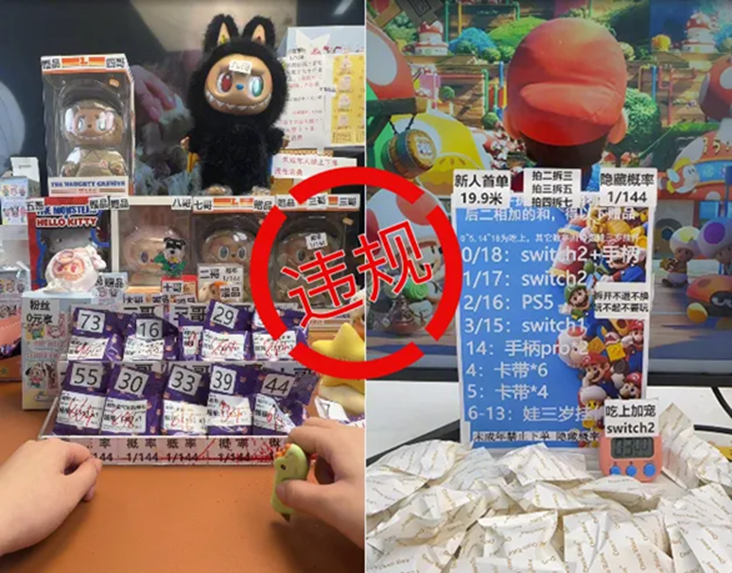
Image source: Douyin E-commerce Safety and Trust Center
Source:Douyin E-commerce Safety and Trust Center
Volcano Engine’s One-Stop AIGC Short-Drama Creation Platform “Volcano Drama Creation 1.0” Was Officially Launched: It Is Deeply Adapted to Models Such as Seedance and Seedream, Can Realize Efficient and Controllable “Director-Level Content Control” Capabilities, and Can Shorten the Production Cycle of Short Dramas by More Than 80%

Image source: Phoenix Technology
Source:Phoenix Technology
Cases
The National Copyright Administration Released Ten Typical Anti-Piracy and Anti-Infringement Cases in the Book Sector for 2025: E-Commerce Platforms Remain High-Incidence Areas for Book Piracy and Copyright Infringement; in Multiple Cases, the Amount Involved Exceeded RMB 10 Million, with the Highest Exceeding RMB 85 Million, and the Longest Sentence Imposed on the Defendants Was Five Years and Nine Months’ Imprisonment
Source: National Copyright Administration