
Key Focus
-
The National Radio and Television Administration (“NRTA”) publicly solicits comments on the Measures for the Development and Administration of Micro-Short Dramas (Draft for Comments) — it is proposed to categorize micro-short dramas into three classes based on investment amount, subject matter, etc., and to implement a categorized system of filing and public disclosure and distribution licensing; to support the creation and production of outward-oriented micro-short dramas and their dissemination “going global”; AI-generated micro-short dramas shall add a prompt label at a conspicuous position in each episode.
-
The NRTA Department of Online Audio-Visual Program Administration issues the Administrative Reminder (Classification and Tiering Criteria for AI Micro-Short Dramas) — the classification investment thresholds for AI micro-short dramas are specifically lowered, while the three-tier management system of “key – ordinary – other” in the micro-short drama sector is still adopted.
-
Hangzhou Binjiang People’s Court concludes a personality rights dispute case involving the AI-based use of a departed employee’s voice — the “identifiability” of the voice after AI processing remains the core of protection; intellectual property authorization obtained by an employer from an employee does not automatically include authorization of personality rights, and the AI-based use of a departed employee’s voice without permission constitutes an infringement of personality rights.
-
Guangzhou Intermediate People’s Court concludes a dispute over a commissioned production contract for a short drama — in the course of actual performance, both plaintiff and defendant jointly produced and disseminated vulgar short dramas, thereby undermining social morality and public decency; the commissioned production contract involved in the case shall be held invalid, and neither party’s claims are to be upheld.
News
-
The National Press and Publication Administration: In June 2026, a total of 163 domestically produced online games and 8 imported online games were approved with publication numbers; from January to June 2026, a total of 949 online games obtained publication numbers, representing a year-on-year increase of approximately 16.9% compared with the same period in 2025 (812 games), including 917 domestically produced online games and 32 imported online games.
-
The first nationwide special case-handling campaign against infringement and piracy in 2026 and the “Jianwang·Jiangsu 2026” centralized action were launched in Suzhou: the campaign will take online infringement and piracy as a key focus, and will concentrate on clues in the fields of online video, music, games, books, film and television, and cultural and creative products for analysis and investigation.
-
The 28th Shanghai International Film Festival successfully boosted film-related sectors as well as transportation, accommodation, catering, tourism and retail industries, generating economic benefits of nearly RMB 5.3 billion, a year-on-year increase of 5.97%; among domestic and overseas audiences coming to Shanghai during the festival, more than 70% came specifically to attend the Shanghai International Film Festival.
-
The 23rd China Digital Entertainment Expo & Conference (ChinaJoy) 2026 will be held on 31 July at the Shanghai New International Expo Center: the theme of this year’s exhibition is “Travel with AI”, with a total exhibition area of more than 140,000 square meters, a record high; nearly 900 enterprises have confirmed participation, including 275 foreign-funded enterprises from 39 countries and regions such as the United States, Canada, the United Kingdom, Germany, Japan and South Korea.
-
The 2026 International Forum on Publishing Industry Leaders was held in Beijing, with the theme “Redefining Publishing in the AI Era”: it was clarified that the core value of AI lies in building a new publishing ecosystem of human-machine collaboration, empowering creators and publishing practitioners rather than replacing human original creativity; practitioners should “hold fast” to the core value of human original creativity.
-
Multiple well-known game media outlets reported that Alibaba is planning to sell its game business brand Lingxi Interactive Entertainment: potential buyers include 37 Interactive Entertainment, China Ruyi, Century Huatong, Giant Network, etc., with a sale price range of RMB 7 billion to 9 billion.
-
Tencent’s Honor of Kings S44 new season has officially launched: the new season introduces a “player co-governance adjudication” function, which can, on the basis of automatic system detection combined with player voting, impose more precise penalties for violations such as “boosting” and cheating.
-
Tencent Video Animation has released a slate of 94 new works including the animation Snow Sword Stride: among them, 26 brand-new IPs are being globally debuted, and production progress updates have been announced for 32 popular IPs; game adaptations have become an important section of the slate, and the classic online game Dungeon & Fighter is being adapted into animation for the first time.
Cases
-
Beijing Shijingshan District People’s Court: part of the lyrics of the song When You Are Old constitute “plagiarism” of the Chinese translation of a poem by the late poet Yuan Kejia, and the relevant singer was ordered to pay RMB 111,000 in damages.
-
Fujian Xiamen Intermediate People’s Court mediated a copyright infringement dispute involving more than one hundred hit songs by Jay Chou: the defendant adopted a bundled business model of “selling goods + giving away audio sources”, and after inducing consumers to place orders, sent links to pirated songs stored on cloud drives; the plaintiff and defendant ultimately reached a settlement under a framework of “economic compensation + comprehensive rectification”.
Key Focus
The NRTA Publicly Solicits Comments on the Measures for the Development and Administration of Micro-Short Dramas (Draft for Comments)
On 24 June 2026, the NRTA issued the Measures for the Development and Administration of Micro-Short Dramas (Draft for Comments) (the “Draft for Comments”) and publicly solicited opinions from the general public, with the deadline for feedback being 23 July 2026. The Draft for Comments aims to establish a full-process regime covering the creation, production, review, distribution, broadcasting, promotion and supervision of micro-short dramas, and to promote the transformation of the micro-short drama industry from rapid expansion to standardized, high-quality and sustainable development. The core points of the Draft for Comments are as follows:
-
Clarifying the definition of micro-short dramas and the scope of application across all channels (Article 2): The Draft for Comments defines micro-short dramas as series with a duration of less than 20 minutes per episode, with a clear main theme, continuous and complete storyline, and prominent characters. The scope of application covers broadcasting channels such as internet websites, apps, distribution platforms, radio and television channels, internet TV, IPTV and cable TV, as well as receiving terminals such as mobile phones, tablets, computers, public electronic screens, smart wearables and in-vehicle devices.
-
Establishing a “three-tier classification” management mechanism (Article 5): Micro-short dramas will be divided into Class I, Class II and Class III based on investment amount and subject matter. Class I micro-short dramas include works with relatively large investment amounts or involving special subject matters such as politics, military affairs, diplomacy, national security, ethnic groups, religion, justice, public security, etc.; Class II covers works with relatively smaller investment amounts and general subject matters; Class III covers works with low investment amounts and general subject matters. The classification criteria will be separately formulated and dynamically adjusted by the State Council’s radio and television authority.
-
Strengthening requirements for filing, public disclosure and pre-broadcast review (Articles 12 to 24): Prior to filming and production, Class I micro-short dramas shall apply for filing and public disclosure, and Class II micro-short dramas may refer to and apply such requirements. Both Class I and Class II micro-short dramas shall undergo content review before broadcasting: upon passing review, Class I micro-short dramas shall obtain a Micro-Short Drama Distribution License, and Class II micro-short dramas shall obtain an approval document; Class III micro-short dramas shall be subject to pre-broadcast review by eligible broadcasting entities, which shall mark the program number. Micro-short dramas that have not obtained the corresponding license, approval document or program number shall not be broadcast or participate in awards or commendations.
-
Further refining content red lines (Article 25): The Draft for Comments systematically enumerates prohibited content, including content endangering national security, undermining ethnic unity, distorting history, infringing upon the rights and interests of minors, insulting or defaming others, promoting obscenity, gambling or drug abuse, money worship, extravagance, discrimination, spreading false information, sensationalizing violence or terrorism, inciting crime or teaching criminal methods, etc.
-
Regulating information labeling, attribution and promotional content (Articles 26 to 28): The titles, lines and subtitles of micro-short dramas shall comply with the norms of the national standard spoken and written language; foreign song lyrics, foreign titles, foreign lines, etc. shall be accompanied by Chinese subtitles. The opening credits shall also indicate the title of the drama, license number, approval document number or program number. Promotional information shall be compatible with the content of the main program and shall not contain illegal or non-compliant content.
-
Imposing stricter primary responsibilities on broadcasting platforms (Articles 29 to 33, 36, 38): Broadcasting entities shall lawfully obtain the corresponding qualifications and establish a chief editor responsibility system for content, a review and gatekeeping mechanism, and a full-process responsibility traceability mechanism for content security. Prior to broadcasting Class I and Class II micro-short dramas, platforms shall verify the license or approval document; for Class III micro-short dramas, platforms shall complete pre-broadcast review on their own, mark the program number, and submit relevant information. Platforms shall also establish a credit evaluation system for key accounts, conduct routine inspections of content providers and promoters, and establish tiered management and exit mechanisms.
-
Strengthening regulation of AI-generated content and algorithmic recommendation (Articles 34, 37): Micro-short dramas generated or produced using artificial intelligence technologies shall add a prompt label at a conspicuous position in each episode. Broadcasting entities shall also periodically review algorithmic mechanisms, models, data and application results, give priority to recommending high-quality micro-short dramas, and shall not use algorithmic models that induce user addiction or excessive consumption.
-
Strengthening consumer protection, data compliance and legal liability (Articles 39 to 49): Broadcasting entities shall lawfully perform their obligations to protect data security, and shall clearly inform users of charging information when providing paid content, thereby protecting consumer rights and interests. For acts such as unauthorized broadcasting, dissemination of prohibited content, failure to produce in accordance with filed content, failure to broadcast in accordance with licensed content, transferring materials for review or providing false materials or data, the competent authorities may order rectification, issue warnings, circulate criticisms, impose fines, and, in serious cases, suspend broadcasting, suspend updates, or revoke licenses.
We understand that this Draft for Comments will raise compliance requirements for all parties along the micro-short drama industry chain: production entities will need, at the project initiation stage, to determine the project category, subject matter sensitivity, investment scale and filing/licensing requirements, and to conduct prior review of scripts, character settings, lines, subtitles, music and AI use; broadcasting platforms will further shift from mere content distributors to substantive compliance obligors, bearing obligations in respect of review, numbering, verification, inspection, handling, algorithm management, account credit management and data security; traffic acquisition, promotion and MCN agencies will need to strengthen compliance review of advertising materials, clip videos, cover titles, live-stream scripts and promotional copy, and avoid high-risk marketing methods such as vulgar borderline content, exaggerated conflict and inducement of top-ups; mini-program short drama and paid operation entities will need to focus on charging prompts, automatic renewal, refund mechanisms, protection of minors, user agreements, privacy policies and data security; AI technology service providers will need to cooperate in establishing mechanisms for labeling generated content, ensuring authorization compliance and traceable management.
Source: National Radio and Television Administration
The NRTA Department of Online Audio-Visual Program Administration Issues the Administrative Reminder (Classification and Tiering Criteria for AI Micro-Short Dramas)
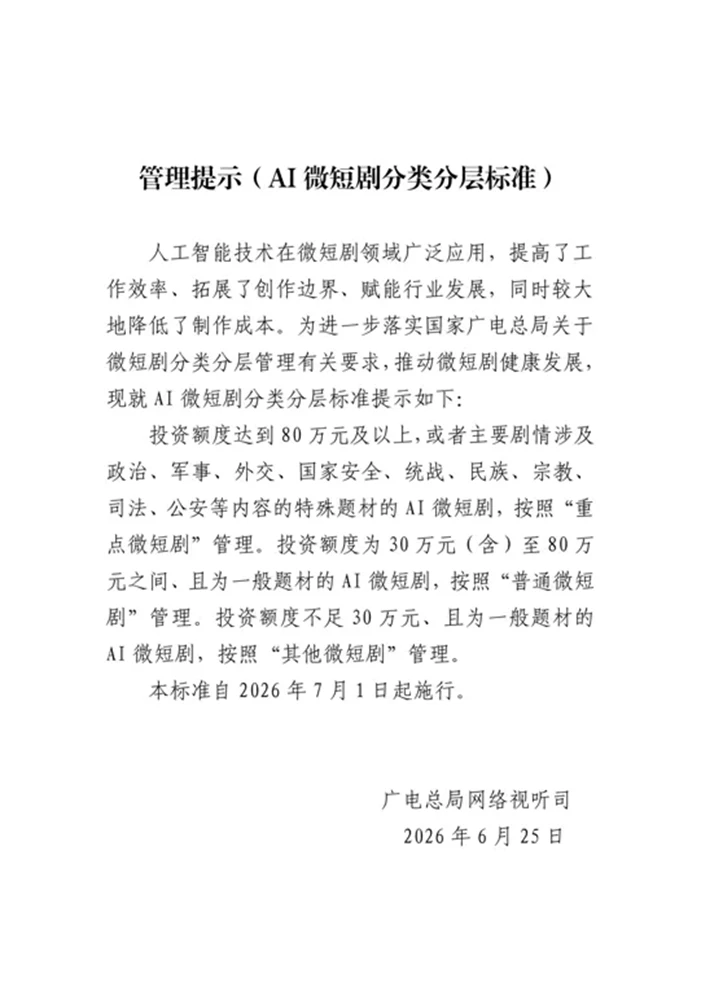
Overall, the Administrative Reminder issued this time does not change the basic types of classification and tiered administration of micro-short dramas, and still adopts the “three-tier classification” framework of “key micro-short dramas”, “ordinary micro-short dramas” and “other micro-short dramas”; its core adjustment lies in the fact that, in view of the significant cost-reducing characteristics of AI technologies, it sets separate investment thresholds for AI micro-short dramas that are lower than those for non-AI micro-short dramas. Specifically, AI micro-short dramas with an investment amount of RMB 800,000 or above, or whose main storyline involves special subject matters such as politics, military affairs, diplomacy, national security, united front work, ethnic groups, religion, justice and public security, shall be administered as “key micro-short dramas”; AI micro-short dramas with an investment amount between RMB 300,000 (inclusive) and RMB 800,000 and with general subject matters shall be administered as “ordinary micro-short dramas”; AI micro-short dramas with an investment amount of less than RMB 300,000 and with general subject matters shall be administered as “other micro-short dramas”.
Compared with non-AI micro-short dramas, the classification thresholds for AI micro-short dramas are significantly lowered. According to the Notice of the General Office of the NRTA on Adjusting the Classification and Tiering Criteria for Micro-Short Dramas (Guangdian Banfa [2025] No. 390), as of 1 January 2026, the investment threshold for “key micro-short dramas” among non-AI micro-short dramas is RMB 3 million or above, the investment amount for “ordinary micro-short dramas” is between RMB 1 million (inclusive) and RMB 3 million, and the investment amount for “other micro-short dramas” is less than RMB 1 million; micro-short dramas with special subject matters are included in the administration of key micro-short dramas regardless of investment amount.
The specific comparison between the classification and tiering criteria for AI micro-short dramas and non-AI micro-short dramas is as follows:
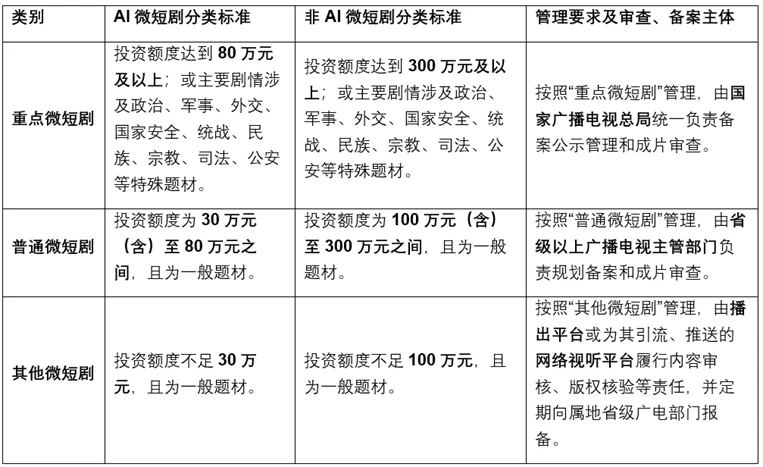
It can be seen that the Administrative Reminder and the Notice on Adjusting the Classification and Tiering Criteria for Micro-Short Dramas are consistent in classification logic, both taking investment amount and subject matter attributes as the core criteria; the difference lies in that AI micro-short dramas are subject to lower investment thresholds. In other words, for the same investment amount of RMB 800,000, a general-subject non-AI micro-short drama has not yet reached the RMB 1 million threshold for “ordinary micro-short dramas”, whereas the corresponding AI micro-short drama has already reached the management standard for “key micro-short dramas”. This arrangement reflects the regulatory authorities’ specific response to the characteristics of AI micro-short dramas, namely “low cost, high efficiency and high output”, and also avoids management misalignment that might result from simply applying the investment standards for non-AI micro-short dramas.
For AI micro-short drama production entities, producers and broadcasting platforms, the most direct compliance impact of the Administrative Reminder is that: whether a work uses AI technologies for generation or production will directly affect the classification and tiering criteria applicable to it and the corresponding management pathway. Therefore, at the project initiation stage, it should first be determined whether the work constitutes an AI micro-short drama, and the investment thresholds of RMB 800,000, RMB 300,000 to RMB 800,000, and less than RMB 300,000 should be applied accordingly, rather than directly applying the standards of RMB 3 million, RMB 1 million to RMB 3 million, and less than RMB 1 million for non-AI micro-short dramas. At the same time, producers should complete investment amount calculation and subject matter determination at the early stage of the project. Any AI micro-short drama whose main storyline involves special subject matters such as politics, military affairs, diplomacy, national security, united front work, ethnic groups, religion, justice and public security shall be administered as a “key micro-short drama” regardless of investment amount.
Source: Guangdian Shijie
Hangzhou Binjiang People’s Court: AI-Based Use of a Departed Employee’s Voice Without Permission Constitutes Infringement of Personality Rights
The plaintiff, Zhou, previously worked for the defendant, Limou Culture Company (the “Defendant Company”), in a “virtual artist” position, responsible for live streaming, video production and other work. The Confidentiality and Intellectual Property Agreement attached to the parties’ labor contract stipulated that intellectual property and other property rights formed during Zhou’s employment would belong to the company. In August 2023, the Defendant Company, citing urgent internal testing needs, arranged for Zhou to cooperate in recording materials for the “Mengmou-Zhou-Voice Use and AI Training Project”, but the parties did not sign a formal cooperation agreement regarding AI training of the voice, subsequent commercial use or authorization fees. After Zhou communicated with the Defendant Company regarding the signing of an agreement and authorization fees, the company did not provide a clear response.
In September 2024, Zhou left the Defendant Company. Thereafter, Zhou discovered that the company, without his permission, had used his recorded voice materials, after AI training, for dubbing the character “Mengmou” in scenarios including live streaming, mall displays and product listing on Steam. Zhou believed that the Defendant Company had infringed his voice rights by unilaterally conducting AI training and use of his voice, and therefore filed a personality rights infringement lawsuit with Hangzhou Binjiang People’s Court, requesting that the company cease the infringement, compensate economic losses of RMB 100,000 and make a public apology. The Defendant Company argued that it enjoyed copyright and other rights over the sound recordings of Zhou’s recorded voice and that the relevant use had a lawful basis.
Upon trial, Hangzhou Binjiang People’s Court held that the protection of a natural person’s voice shall be applied by reference to the rules for the protection of portrait rights, with “identifiability” as the core criterion. A voice processed by artificial intelligence technologies, if it can still enable the general public to associate it with a specific natural person based on characteristics such as timbre, tone and pronunciation style, remains within the scope of protection of voice rights. In this case, the AI-processed voice was highly consistent with Zhou’s tone and pronunciation style, sufficient to enable the general public to identify Zhou’s personal identity, and therefore still falls within the scope of protection of Zhou’s voice rights and is protected under the Civil Code.
The court further pointed out that even if an employer may enjoy copyright and other intellectual property rights over sound recordings recorded by employees, the agreement on intellectual property ownership does not automatically include authorization of personality rights, and it cannot be inferred that the employer is thereby entitled to conduct AI training, synthesis and commercial use of the employee’s voice. The Defendant Company had previously communicated with Zhou regarding voice authorization and fees, indicating that it was aware that AI training and use of Zhou’s voice required separate authorization. In the absence of Zhou’s informed consent, the company AI-processed Zhou’s voice and used it for dubbing a virtual character, lacking a lawful rights basis and constituting an infringement of Zhou’s voice rights. Ultimately, the court ordered the Defendant Company to cease the infringement and compensate economic losses of RMB 20,000, and to issue a written apology; neither party appealed the first-instance judgment.
Source: Hangzhou Intermediate People’s Court
Guangzhou Intermediate People’s Court: Where Both Parties Know that Short Drama Content Violates Public Order and Good Morals Yet Proceed to Complete Filming and Launch, the Commissioned Production Contract Shall Be Held Invalid
He Company and Tao Company entered into a Film and Television Drama Commissioned Production Contract in 2023, under which Tao Company was to undertake the filming and production of an online micro-short drama, and it was expressly stipulated that the final content must comply with laws and regulations and conform to public order and good morals. During contract performance, Tao Company completed the production of the short drama and delivered the final cut, and He Company subsequently launched the short drama on online platforms for broadcasting.
After the series went online, the parties became embroiled in a dispute over payment of the remaining production fees: Tao Company claimed that it had fulfilled its commissioned production obligations and requested that He Company pay the remaining production fees and capital occupation fees; He Company, on the other hand, refused to pay the remaining fees on the grounds that the content of the short drama clearly violated public order and good morals and that the drama had been taken down by the platform after launch, and filed a counterclaim seeking termination of the contract, return of amounts already paid and payment of liquidated damages for delayed delivery. Dissatisfied with the first-instance judgment, both parties appealed to Guangzhou Intermediate People’s Court.
Upon trial, Guangzhou Intermediate People’s Court held that civil subjects shall not violate laws or public order and good morals when engaging in civil activities. In this case, the short drama involved in the case contained violations such as revealing costumes worn by actors and vulgar plotlines. Throughout the entire process from filming and production to launch review, He Company followed up and supervised, yet never raised objections to the vulgar content, and was therefore found to have been aware of and acquiesced in the vulgar borderline content of the short drama, as was Tao Company. In actual performance, the parties jointly produced and disseminated vulgar short dramas, thereby undermining social morality and public decency, and the commissioned production contract involved in the case shall therefore be held invalid in accordance with law. After the contract is held invalid, as both parties are clearly at fault, they shall each bear corresponding responsibilities, and thus neither party’s claims for payment, refund or termination can be upheld. Ultimately, Guangzhou Intermediate People’s Court, in its second-instance judgment, dismissed all claims of both parties, and the judgment has become effective.
Source: Guangzhou Intermediate People’s Court
News
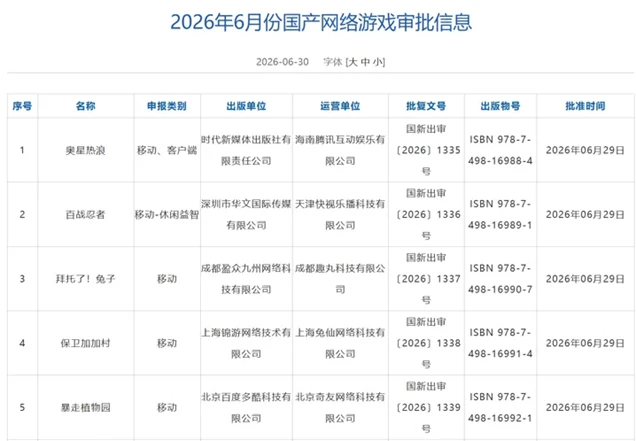
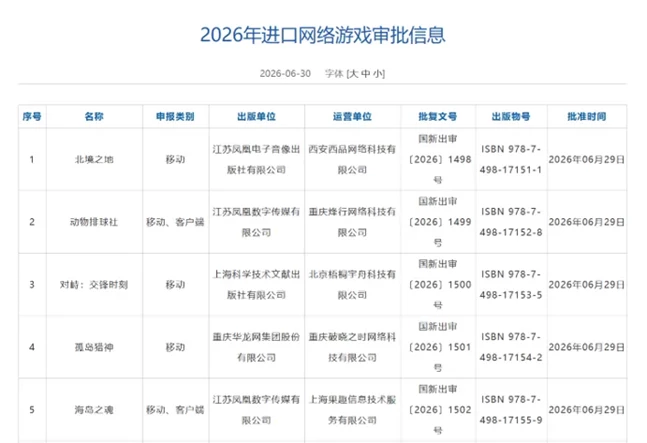
Image source: National Press and Publication Administration
Source: National Press and Publication Administration
Source: Yangtze Evening News Online
Source: Xinhua News Agency
Source: Xinhuanet
Source: National Press and Publication Administration
Source: Sina Finance & Securities
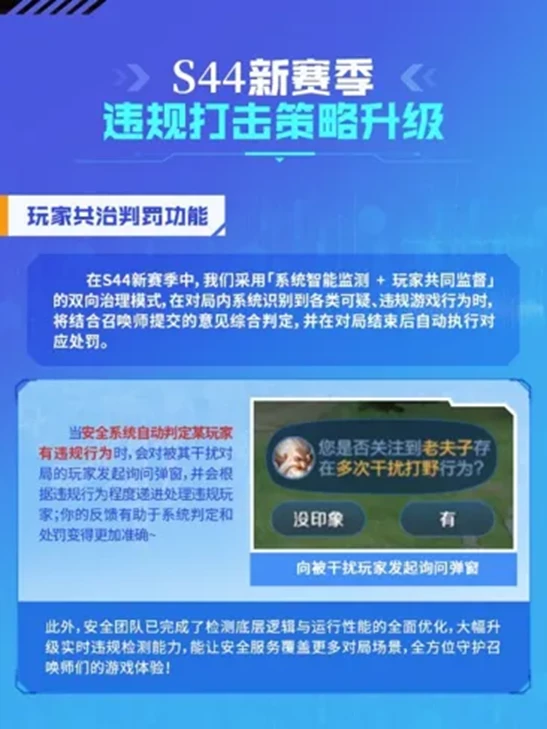
Image source: Honor of Kings official Weibo, IT Home
Source: Honor of Kings official Weibo, IT Home
Source: Beijing News
Cases
Source: Yangtze Evening News
Source: Haixia Daobao