

Cartier and Guangzhou Watch Company dispute over unauthorized use of another party’s product get-up with certain influence.
Brief Case Summary
Cartier is one of the world’s leading luxury goods suppliers. The “Cartier” brand was founded in Paris, France in 1847 and has since been renowned worldwide for its exquisitely designed jewelry and watch products. In 1983, Cartier officially entered China. After more than thirty years of development, Cartier has opened more than 40 boutiques and numerous franchised stores in China. As one of the most popular products of the Cartier brand worldwide, the Cartier Tank watch not only enjoys a high reputation globally, but has also been widely recognized and admired by Chinese consumers since its entry into the Chinese market, and is well known to the relevant public. It has accumulated substantial fame and influence, and its get-up constitutes “product get-up with certain influence” protected under the Anti-Unfair Competition Law.
Cartier discovered that Guangzhou Watch Companies without authorization, manufactured and sold watch products whose get-up was highly similar to the product get-up with certain influence of the Cartier Tank watch, and that such conduct had already caused confusion and misidentification among relevant consumers. Their conduct constituted unfair competition, and Cartier therefore filed a lawsuit with the Shenzhen Intermediate People’s Court.
Upon trial, the court found that: (1) the get-up of the Cartier Tank watch constitutes product get-up with certain influence, and the manufacture and sale by Guangzhou Watch Companies of watch products whose get-up is identical or similar to the Tank watch get-up with certain influence of Cartier constitute unfair competition; (2) Guangzhou Watch Companies acted with obvious subjective bad faith; (3) the accused infringing products were launched in November 2017, were manufactured and sold in large quantities and over a wide scope, involving platforms such as Tmall, JD.com, Pinduoduo, and Douyin, and it was publicly claimed that there were 140 offline sales outlets nationwide; (5) the accused infringing products had a relatively high profit margin. The court therefore determined, based on the upper limit of statutory damages, that Guangzhou Watch Companies shall compensate Cartier for economic losses and reasonable expenses in a total amount of RMB 5 million.
Guangzhou Watch Companies dissatisfied with the first-instance judgment, filed an appeal. Upon trial, the court of second instance dismissed the appeal and upheld the first-instance judgment.
Key Points of the Judgment
On Issue 1: Whether the get-up of the Cartier Tank series watches constitutes “product get-up with certain influence” as provided in the Anti-Unfair Competition Law
When determining whether the indicia provided in Article 6 of the Anti-Unfair Competition Law have a certain degree of market recognition, the people’s court shall comprehensively consider such factors as the degree of awareness among the relevant public within the territory of China, the time, region, volume, and targets of product sales, the duration, extent, and geographical scope of publicity, and the circumstances of protection of the indicia.
Cartier contended that the Cartier Tank watch for which it sought protection was designed with unique features based on the reference to the shape of a tank, and that its inherent distinctiveness in get-up is manifested in the rectangular dial, vertically parallel lugs, and railway track minute markers. Since entering the Chinese market, the Cartier brand has carried out extensive and continuous publicity for the Cartier brand and the Cartier Tank series watches through online and offline advertising and numerous physical stores across the country. The Cartier brand enjoys a high degree of fame, and the Cartier Tank series watches have also become products with certain influence. At the same time, the sword-shaped hands, Roman numerals radiating outward from the central axis, and cabochon sapphire crown in the get-up of the Cartier Tank series watches have also acquired distinctive features through continuous publicity and use. The inherently distinctive design elements in the get-up of the Cartier Tank series watches and the distinctive design elements acquired through use together constitute product get-up with a high degree of fame that is capable of distinguishing the source of goods, and fall within “product get-up with certain influence” as provided in Article 6 of the Anti-Unfair Competition Law of the People’s Republic of China.
On Issue 2: Whether the get-up of the accused infringing products is likely to cause confusion among the relevant public as to the source of the goods
The two defendants, without authorization, used on their watches product get-up similar to that of the Cartier Tank watch. It is difficult for the relevant public not to mistakenly believe that the two products originate from the same provider or that there is a specific connection between the providers of the two products, such as licensed use or an affiliated enterprise relationship. Trademarks and product get-up are different commercial indicia. Even if the two defendants also used their own trademarks on their products, this cannot eliminate the confusion as to source caused by the use of similar product get-up. The relevant public is not limited to consumers who actually purchased the accused infringing products, but also includes business operators and other potential purchasers. The substantial price difference between the accused infringing products and Cartier’s products cannot negate the possibility of confusion as to source between the two products.
On Issue 3: Whether the amount of damages for infringement determined in the first-instance judgment is appropriate The court comprehensively considered:
(1) the product get-up of the Cartier Tank watch has already acquired certain influence in the minds of the relevant public, and the two defendants, as professional watchmaking companies, manufactured watches by imitating Cartier’s product get-up, demonstrating very obvious subjective bad faith;
(2) the two defendants failed to cease the infringing acts after receiving multiple warning letters, which constitutes willful infringement with serious circumstances;
(3) the two defendants are the manufacturers and sellers of the infringing products and are the source of the infringing products;
(4) the duration of the infringement was long;
(5) the unit price of the accused infringing products exceeds RMB 2,000, and they were sold on multiple platforms with huge sales volume;
(6) Cartier’s reasonable expenses for rights protection and other factors, and ordered the two defendants to jointly compensate Cartier for economic losses and reasonable expenses in a total amount of RMB 5 million.
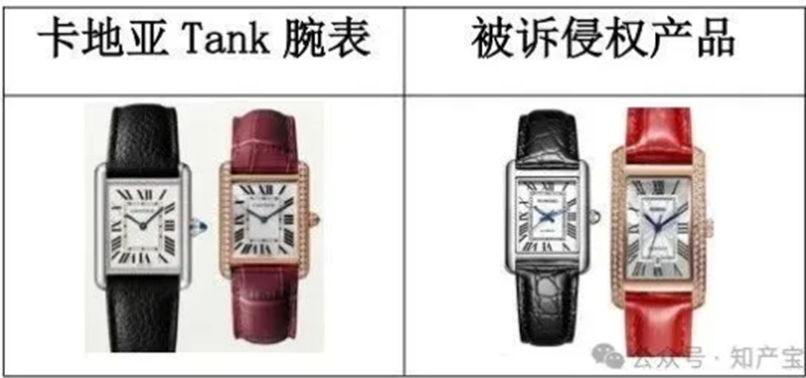
Appendix: Product comparison chart